


The medical name for fish skin is ichthyosis, from the Greek word ichthys, meaning fish. It covers a group of mostly inherited conditions in which the skin does not shed properly, so dead cells build up into dry, rough scale that can look like the scales of a fish. Each type has its own name, the commonest being ichthyosis vulgaris.
People also use plenty of everyday names for the same look, such as fish scale skin, crocodile skin, alligator skin and snake skin. None of those is a diagnosis, so this page sets out what each name means, which medical terms sit behind them, and how ichthyosis differs from ordinary dry skin.
Where the word ichthyosis comes from
The word is built from the Greek ichthys, fish, and the suffix -osis, which in medicine means a condition or process. So ichthyosis literally means "fish condition". It was named for how the skin looks, not for anything to do with fish themselves, and it has nothing to do with eating fish, swimming or hygiene.
You will see a few related words in letters from doctors and in dermatology leaflets:
- Ichthyoses is the plural, used when talking about the whole group of conditions.
- Ichthyotic describes skin that shows this kind of scaling, as in "ichthyotic skin on the shins".
- Ichthyosiform means "looking like ichthyosis", used for scaling that resembles it, sometimes from a different cause.
- Hyperkeratosis is the general term for a thickened outer layer of skin, which ichthyosis is one example of. Our thickened skin guide covers that wider picture.
The names of the main types
Ichthyosis is not one condition but a family of them, named mainly by how they are inherited and how the scale looks. The ones you are most likely to come across are below.
| Name | When it usually shows | What it typically looks like |
|---|---|---|
| Ichthyosis vulgaris | Early childhood, often after the first year | Fine, pale scale on shins and outer arms, creases often spared |
| X-linked ichthyosis | Infancy, almost always in boys and men | Larger, darker, more stuck-down scale, often including the neck |
| Lamellar ichthyosis | At birth, often as a collodion baby | Large plate-like scale over much of the body |
| Epidermolytic ichthyosis | At birth or soon after | Blistering and fragile skin early on, later thick ridged scale |
| Acquired ichthyosis | Adulthood, with no childhood history | Scale resembling ichthyosis vulgaris, linked to another cause |
A few notes on those names. "Vulgaris" is Latin for common, not a comment on how it looks; it is the everyday form and the one most people mean when they say fish skin. X-linked ichthyosis gets its name from the X chromosome, which is why it is passed down through mothers and mainly affects males. Lamellar comes from the Latin for thin plates. Epidermolytic means the outer layer of skin (the epidermis) is breaking down, which is why blistering is part of the picture; older textbooks call it bullous ichthyosiform erythroderma. Acquired ichthyosis is the odd one out because it is not inherited, and it is the one that always needs a doctor to look for the cause.
There are rarer types too, including harlequin ichthyosis, the most severe form, which needs specialist hospital care from birth. We have separate pages on X-linked ichthyosis and lamellar ichthyosis if you want detail on a particular type.
Everyday names people use
Most people never hear the word ichthyosis until a GP says it. Before that, they describe what they can see, and a handful of names come up again and again.
Fish scale skin
The closest everyday match to the medical word, since both describe the same fish-like scale. Our fish scale skin guide goes into why the skin does this and what helps.
Crocodile skin or alligator skin
Used for skin that has broken into tiled plates with fine cracked lines between them, usually on the shins. This can be ichthyosis, but it can also be very severe dryness in adults, which doctors call asteatotic eczema or eczema craquelé. Our crocodile skin guide explains how to tell the two apart.
Snake skin
Usually describes a fine, shiny, overlapping scale, or skin that seems to peel in sheets. Again, it can be ichthyosis or simply very dry skin.
Other names you may hear
- Collodion baby, for a newborn born in a tight, shiny, film-like membrane, often the first sign of an inherited ichthyosis.
- Xerosis, the medical word for dry skin, which is not the same thing as ichthyosis.
- Fish skin disease, an older and rather unkind phrase you may still see online.
A name is not a diagnosis. Fish, crocodile and snake skin are descriptions of how skin looks. Two people using the same phrase can have quite different conditions, and the right care depends on which one it is. If your skin has looked like this for years, a GP can usually tell you which type it is from looking and asking about your family.
How ichthyosis differs from ordinary dry skin
Ordinary dry skin and ichthyosis can look similar on a cold winter day, but they are different problems underneath.
- Cause. Dry skin is mostly a water problem: the skin loses moisture faster than it holds it. Ichthyosis is a shedding problem: dead cells are not released properly, so they pile up.
- Timing. Dry skin often comes and goes with the seasons, washing habits or age. Inherited ichthyosis has usually been there since childhood and never fully goes away.
- Family. Ichthyosis often runs in families. Ordinary dry skin usually has no clear pattern.
- Response to moisturiser. Dry skin generally settles with a good emollient. Ichthyosis softens with moisturiser but the scale tends to come back within hours, because the build-up itself is still there.
- Clues on the hands. Ichthyosis vulgaris often comes with very lined palms and sometimes keratosis pilaris on the upper arms.
If you are unsure which you have, our guide to xerosis covers ordinary dry skin in more depth.
Where G16 fits, and where it does not
G16 Skin Repair is a light, non-greasy body lotion made for the build-up side of the problem. Glycolic acid, the second ingredient after water, and lactic acid loosen the built-up dead skin so it can lift away. Aloe vera, glycerin, panthenol, allantoin, vitamin E and shea butter hydrate the skin underneath as that happens.
Used twice daily and left on as long as possible, there is often a flakier phase around day five to seven as loosened scale comes away, and most people see a visible difference within the first two weeks. The full course is 28 days. Ichthyosis is genetic, so a lotion changes how the skin looks and feels rather than the condition itself, and it needs ongoing use.
It is not for babies or young children unless a doctor advises it, not for broken, cracked or infected skin, and not for harlequin ichthyosis, which needs specialist hospital care. Patch test first, keep it away from the eyes, and use sunscreen on exposed areas, since acids increase sun sensitivity. A cheaper urea cream from a pharmacy is a sensible first try for milder scale.
When to see a GP
- Scaly, fish-like skin that has appeared for the first time in adulthood, with no childhood history.
- Scaling with tiredness, weight change, feeling cold, thirst or feeling generally unwell.
- A baby or child with scaly skin that has never been diagnosed.
- Red, sore, weeping or blistering skin, or signs of infection such as heat, spreading redness or pus.
- Deep cracks that bleed or will not heal.
- Scale that is getting thicker quickly, or that is affecting your confidence or daily life.
Common questions
Ichthyosis. The word comes from the Greek ichthys, meaning fish, and describes a group of mostly inherited conditions in which dead skin cells build up into dry scale. The commonest type is ichthyosis vulgaris. Others include X-linked, lamellar and epidermolytic ichthyosis, plus acquired ichthyosis, which develops in adulthood.
There is no single medical name, because crocodile skin is a description rather than a diagnosis. When it has been there since childhood it is usually ichthyosis. When it appears in adulthood, often on the shins in winter, it is more often severe dryness, which doctors call asteatotic eczema or eczema craquelé. A GP can tell you which one you have.
It means common ichthyosis. Vulgaris is Latin for common or ordinary, and the name simply marks it out as the everyday form. It usually appears in early childhood, tends to run in families, and causes fine pale scale mainly on the shins and the outer arms, often with very lined palms.
Not quite. Ordinary dry skin, called xerosis, is mainly about lost water and usually settles with moisturiser. Ichthyosis is about dead cells not shedding properly, so they build up into scale. Moisturiser softens that scale but rarely removes it, which is why people with ichthyosis often find it comes back within hours.
No. Ichthyosis is caused by genes that affect how skin cells are made and shed, or occasionally by another health condition. You cannot catch it or pass it on by touch, towels or swimming pools, and it has nothing to do with how often someone washes.
The product behind this guide
G16 Skin Repair is a glycolic and lactic acid body lotion for built-up, scaly and thickened skin.
200ml. Made in the UK. 21 day money back guarantee.
Ichthyosis treatment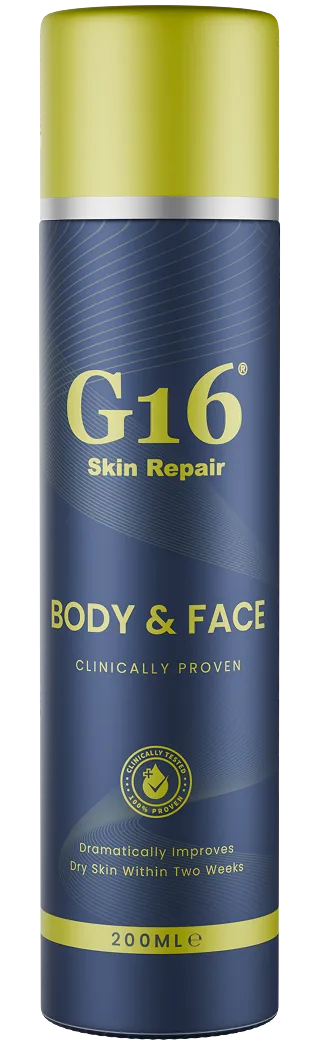
G16 Skin Repair Lotion is a cosmetic moisturiser. Patch test on a small area before first use, keep it away from the eyes and mucous membranes, and keep it out of reach of children. If your skin is broken, bleeding or infected, or if it gets worse rather than better, speak to a GP or a dermatologist.
