



Most people with keratosis pilaris have spent years being told to exfoliate more, and have the irritated arms to show for it. So here is the honest version. It cannot be cured, because it is genetic and lifelong, and anything promising to eliminate it permanently is overselling. What it can be is so much less visible that you stop thinking about it, and for most people that takes around two months of doing the right things.
It is also far more common than people realise. Somewhere between one in five and two in five adults have it to some degree, and most of them have never had it named.
What it actually is
Each hair on your body grows out of a follicle. In keratosis pilaris, keratin, the protein your skin is made of, builds up and plugs the opening of the follicle instead of shedding normally. The plug traps the hair underneath, and the result is a small firm bump.
Multiply that across an area and you get the characteristic texture: rough like fine sandpaper, often described as chicken skin or goosebumps that never go down. Colour varies. On paler skin the surrounding area often looks pink or red; on deeper skin tones the bumps tend to read brown or darker than the surrounding skin.
It sits on the backs of the upper arms most often, then the fronts of the thighs, the buttocks and sometimes the cheeks. It is not contagious, not caused by poor hygiene, and not dangerous.
What makes it worse
- Dry skin. The strongest single factor. KP is almost always worse in winter and better in humid weather.
- Genetics. It runs in families and is associated with the same filaggrin gene changes involved in ichthyosis vulgaris, which is why the two often occur together.
- Age. Usually appears in childhood, peaks in adolescence, and frequently improves through the thirties and beyond.
- Hormonal change, including pregnancy.
- Scrubbing and picking, which irritate the follicle and leave marks that last far longer than the bump did.
What actually works
Three things, done together and kept up. Any one of them alone underperforms.
1. Chemical exfoliation, not physical
The plug is inside the follicle. A scrub abrades the surface and cannot reach it, while the irritation prompts more keratin production. Acids get in.
- Glycolic and lactic acid loosen the bonds between the dead cells making up the plug. Lactic acid also holds water in the skin, which helps with the dryness at the same time.
- Salicylic acid is oil-soluble and works into the follicle. Good, particularly where the bumps are inflamed.
- Urea at 10 to 20 per cent both softens keratin and hydrates. Inexpensive and stocked everywhere.
Apply to dry skin and leave it on. Applying acid in the shower wastes it. Start every other day, build up as the skin tolerates it.
2. Moisturise relentlessly
This is not optional and it is not the boring part. Dry skin sheds unevenly, which is what forms the plugs. Every study and every dermatologist puts consistent moisturising at the centre of managing KP. Twice daily, and immediately after bathing while the skin is damp.
3. Stop irritating it
- No loofahs, exfoliating gloves or gritty scrubs.
- Do not pick. Picking a KP bump leaves a dark mark for months and can scar.
- Shorter, cooler showers and a non-soap cleanser.
- A humidifier through the winter genuinely helps.
If that is not enough
A GP or dermatologist can prescribe a topical retinoid such as tretinoin or adapalene, which normalises how the follicle sheds. It works well for many people, takes months, and causes dryness and irritation early on. Not suitable in pregnancy.
The realistic outcome. Redness and roughness usually improve a great deal. The bumps become far less noticeable. But KP is a tendency, not an event, so if you stop treating it, it returns within a few weeks. Think of it like brushing your teeth rather than taking a course of antibiotics.
What does not work
- Antibacterial washes. KP is not an infection.
- Scrubbing harder. Reliably makes it worse.
- Coconut oil alone. Moisturising but does nothing to keratin.
- Cutting out gluten or dairy. No evidence supports a dietary cause.
- Sunbathing. KP often looks better with a tan because the contrast reduces, but the damage is not worth it and the texture is unchanged.
Where G16 fits, and where it does not
G16 Skin Repair covers two of the three steps at once: it is a glycolic and lactic acid lotion, so it is doing the chemical exfoliation, and the aloe vera, glycerin, panthenol and shea butter handle the moisturising that has to happen alongside it. Being a lotion rather than a spot treatment, it covers whole arms and legs, which is the area KP actually occupies.
It suits rough, bumpy, dry KP, which is the common presentation.
It is not the better choice where bumps are red and inflamed rather than simply rough, since salicylic acid tends to suit that better. It is not for broken or infected skin. And it will not do anything about the underlying tendency, because nothing will. This is management, not cure.
If cost is the deciding factor, a 10 per cent urea cream from a pharmacy plus a decent moisturiser does much the same job for less. G16 makes more sense if you want one product doing both jobs, or if you also have dryness or scale elsewhere.
When to see a doctor
- The bumps are painful, hot, or producing pus, which is folliculitis rather than KP.
- There has been no improvement after three months of consistent treatment.
- It is spreading rapidly or appeared suddenly in adulthood.
- It is causing real distress. Prescription options exist and it is a legitimate reason to ask.
- You are getting scarring or persistent dark marks.
Common questions
Not permanently, because it is genetic. Many people do find it fades substantially with age, often through their thirties and forties, and some find it disappears in adulthood without doing anything. With consistent treatment it can be made barely noticeable, but stopping treatment brings it back within weeks.
Texture usually softens within the first two weeks. Redness and the visible bumps take longer, generally four to twelve weeks of daily use. Any associated dark marks fade slowest of all, over several months. Consistency matters far more than the strength of what you use.
Overlapping but not identical. Strawberry legs describes a look, dark dots on the legs, and keratosis pilaris is one of four things that can cause it. The others are open pores, folliculitis and ingrown hairs. If the skin feels rough to the touch it is keratin; if it feels smooth and the dots are only visual, it is probably not KP.
There is no good evidence that it does. Cutting out gluten or dairy is a popular suggestion online with nothing behind it. General skin health benefits from adequate hydration and a reasonable diet, but KP itself is a structural, genetic issue rather than a dietary one.
Dryness is the biggest aggravating factor, and cold air plus indoor heating is the driest environment your skin meets all year. Dry skin sheds unevenly, which is exactly what plugs the follicles. A humidifier, shorter and cooler showers, and stepping up the moisturising from autumn onwards all make a measurable difference.
The product behind this guide
G16 Skin Repair is a glycolic and lactic acid body lotion for built-up, scaly and thickened skin.
200ml. Made in the UK. 21 day money back guarantee.
Keratosis treatment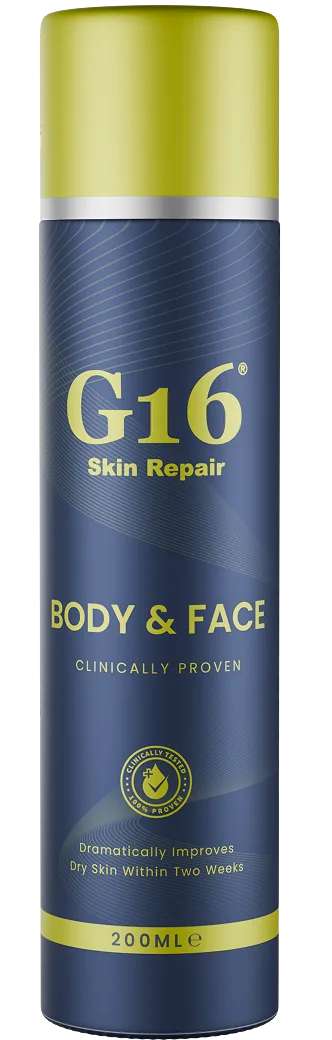
G16 Skin Repair Lotion is a cosmetic moisturiser. Patch test on a small area before first use, keep it away from the eyes and mucous membranes, and keep it out of reach of children. If your skin is broken, bleeding or infected, or if it gets worse rather than better, speak to a GP or a dermatologist.
