


If you have a drawer of half-used moisturisers that each worked for about a week, the problem probably is not the products. It is that dry skin has two quite different causes, and most products only deal with one of them. Either your skin is losing water faster than it can hold on to it, or it is not shedding dead cells properly and they are building up on the surface. They look the same in the mirror. They need different things done about them.
The everyday causes
Hot water and long showers
This is the most common cause and the easiest to fix. Hot water strips the oils that hold moisture in the skin. A long hot shower feels wonderful and leaves your skin measurably drier than when you got in. If your skin feels tight within a few minutes of drying off, this is very likely a contributor.
What to change: lukewarm rather than hot, and keep it under ten minutes. Pat dry rather than rubbing, and moisturise while the skin is still slightly damp, ideally within three minutes.
Soap and harsh cleansers
Traditional soap is alkaline and strips the skin's acid mantle. Foaming shower gels usually contain sulphates, which are effective degreasers, which is exactly the problem. The more it lathers, the more it is likely stripping.
What to change: a non-soap cleanser, sometimes labelled syndet or emollient wash. Use it where you actually need it rather than over the whole body.
Hard water
If you live in a hard-water area, the dissolved calcium and magnesium react with soap to leave a residue on the skin and make cleansers harder to rinse off. Hard water has been linked with drier, more irritable skin, particularly in people who already have a tendency to it.
What to change: a water softener helps if you have one. Failing that, rinse thoroughly and switch to a low-foaming cleanser, which leaves less residue to react with.
Central heating, air conditioning and cold air
Cold air holds much less water than warm air, and heating a cold house dries the indoor air further. The result is a low-humidity environment that pulls water out of your skin all day. This is why so many people find their skin is fine in summer and cracks every winter.
What to change: a humidifier in the rooms you spend most time in, or simply a bowl of water near a radiator. Aim for something in the region of 40 to 60 per cent humidity.
Causes you cannot change, and what to do instead
Getting older
From around your forties, the skin produces less sebum and fewer of the natural moisturising factors that hold water in the outer layer. Cell turnover also slows, so dead cells sit on the surface for longer. By seventy, dry skin is close to universal rather than unusual.
This one is not reversible, but it responds well to treatment. It is also the group where a build-up of dead skin, rather than simple water loss, is often the bigger part of the problem.
Genetics: ichthyosis vulgaris
Roughly one person in every 250 carries a change in the filaggrin gene, which is part of how the skin barrier is built and how dead cells are released. The result is skin that does not shed properly, so the dead cells accumulate into fine or plate-like scale, most often on the shins and outer arms.
It usually shows up in childhood, runs in families, and gets better in humid weather and worse in winter. If your dry skin has been there as long as you can remember, is scaly rather than merely tight, and someone else in the family has it too, this is worth looking into.
How to tell the two problems apart. Press a fingernail gently across the dry patch. If you can lift or scrape a fine flake or scale off, the problem includes a build-up of dead skin and a plain moisturiser will only ever give you temporary relief. If the skin is tight and rough but nothing lifts, it is mostly water loss, and a good emollient is the right answer.
Medical causes worth ruling out
Dry skin that appears suddenly, gets worse despite good skincare, or comes with other symptoms is worth a GP appointment rather than another lotion. The usual suspects:
| Cause | Other signs to look for |
|---|---|
| Underactive thyroid | Tiredness, weight gain, feeling cold, thinning hair, constipation |
| Diabetes | Thirst, passing urine often, unexplained weight loss, slow-healing cuts |
| Kidney disease | Itching without a rash, swollen ankles, fatigue |
| Nutritional deficiency | Poor wound healing, hair loss, brittle nails |
| Medication | Started within weeks of a new prescription. Diuretics, statins, retinoids and some acne treatments are common culprits |
| Eczema or psoriasis | Redness, inflammation, defined patches, itching that dominates. These are inflammatory conditions and need their own treatment |
What actually helps
Skincare products for dry skin do one of three jobs. Most products do more than one, and knowing which you need saves a lot of money.
- Occlusives sit on top and physically slow water escaping. Petrolatum, mineral oil, dimethicone, shea butter. The most effective at stopping water loss and the greasiest to wear.
- Humectants pull water into the outer layer and hold it there. Glycerin, urea at lower strengths, hyaluronic acid, panthenol. Light and comfortable, but in very dry air they need an occlusive over the top or the water just leaves again.
- Keratolytics loosen the bonds holding dead cells together so the build-up comes away. Urea at higher strengths, salicylic acid, and the alpha hydroxy acids, glycolic and lactic. These are the ones that matter when the problem is accumulation rather than dryness.
If a moisturiser has never quite worked for you, there is a good chance you have been treating a build-up problem with a water-loss product. That is the most common mismatch there is.
The order that works
- Fix the water first: cooler, shorter showers, a non-soap cleanser, moisturise on damp skin.
- Add humidity if it is a winter problem.
- If the skin is still scaly or rough after a few weeks, add something keratolytic to deal with the build-up.
- If nothing shifts, or there are other symptoms, see a GP. Persistent dry skin is occasionally the first sign of something systemic.
Where G16 fits, and where it does not
G16 Skin Repair is a keratolytic lotion. It leads with glycolic acid alongside lactic acid, so its job is the third category above: loosening built-up dead skin so it lifts and comes away, while aloe vera, glycerin, panthenol and shea butter hydrate the newer skin underneath.
That makes it a good fit if your dry skin is scaly, flaky or rough to the touch, if you can lift flakes off, or if ordinary moisturisers soften things temporarily but the roughness always returns.
It is not the right answer if your skin is simply tight and dehydrated with nothing to remove, in which case a plain emollient is cheaper and better. It is not for broken, bleeding or infected skin. And it will not do anything about a thyroid problem, a medication side effect or an inflammatory condition, which need treating at the source.
When to see a doctor
- The skin is cracked deeply enough to bleed, or looks infected: hot, swollen, weeping or yellow-crusted.
- The dryness came on suddenly and you cannot account for it.
- It is getting worse despite several weeks of sensible care.
- It comes with fatigue, weight change, unusual thirst or swelling.
- The itch is severe enough to disturb your sleep.
- It is a young child or an older person whose skin is breaking down.
Common questions
Usually because the moisturiser is treating the wrong problem. If dead skin is building up on the surface, a moisturiser softens it for a few hours but does not remove it, so the roughness always comes back. Try the fingernail test above: if you can lift a flake, you need something that loosens the build-up rather than something that adds water.
It contributes rather than causes. The dissolved minerals make soap harder to rinse away and leave a residue that can irritate. It tends to matter most for people whose skin is already prone to dryness. A softener helps, and so does switching to a low-foaming, non-soap cleanser.
Usually not. Most dry skin is environmental or genetic. But dryness that appears suddenly, worsens despite good care, or comes alongside fatigue, weight change, unusual thirst or swelling is worth a GP appointment, because an underactive thyroid, diabetes and kidney problems can all show up in the skin first.
Dry skin is short of oil, which is largely down to genetics and age. Dehydrated skin is short of water, which is usually environmental and temporary. Oily skin can be dehydrated. The practical difference is that dry skin needs replacing what it cannot make, while dehydrated skin usually improves once you stop stripping it.
Simple environmental dryness often settles within a week or two of changing how you wash and moisturise. Built-up scale takes longer, because the accumulation has to be cleared before the new skin shows: most people see a visible difference within the first two weeks, and a full course is around 28 days.
The product behind this guide
G16 Skin Repair is a glycolic and lactic acid body lotion for built-up, scaly and thickened skin.
200ml. Made in the UK. 21 day money back guarantee.
Dry skin treatment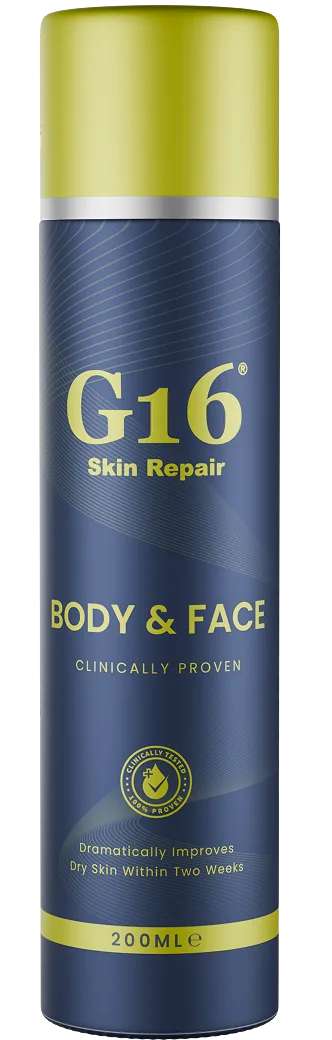
G16 Skin Repair Lotion is a cosmetic moisturiser. Patch test on a small area before first use, keep it away from the eyes and mucous membranes, and keep it out of reach of children. If your skin is broken, bleeding or infected, or if it gets worse rather than better, speak to a GP or a dermatologist.
