



"Fish scale skin" is the everyday name for ichthyosis, and the medical term comes from exactly the same observation. Ichthys is Greek for fish. It describes a group of conditions where the skin does not shed properly, so dead cells accumulate on the surface and organise into visible, often plate-like scale. The commonest form, ichthyosis vulgaris, affects roughly one person in 250.
It is not contagious, it is not caused by poor washing, and it is not simply very dry skin, though it is regularly mistaken for all three.
Why the skin does this
Normal skin sheds a cell at a time, invisibly, replacing its outer layer roughly every four weeks. In ichthyosis that process fails at one of two points: the skin either produces cells faster than it can clear them, or it fails to release the bonds holding old cells together. Either way, cells accumulate.
In ichthyosis vulgaris the underlying issue is usually a reduced amount of filaggrin, a protein that helps flatten and bind cells in the outer layer and contributes to the skin's natural moisturising factor. Less filaggrin means poorer barrier function, more water loss, and scale.
The practical consequence. Because the problem is retention rather than dryness, moisturiser alone never quite finishes the job. It softens the scale and makes the skin more comfortable, but the accumulated layer is still sitting there. That is why people with ichthyosis often describe creams as working for a few hours and then the scale looking exactly the same.
How to recognise it
- Present since childhood, usually appearing in the first few years of life rather than arriving in adulthood.
- Fine to plate-like scale, classically on the shins and the extensor surfaces of the arms, often sparing the creases of elbows and knees.
- Worse in winter, often noticeably better in warm humid weather.
- Very fine lines on the palms, called hyperlinearity, a recognised marker of ichthyosis vulgaris.
- Often a family history, since most forms are inherited.
- Frequently alongside keratosis pilaris and a tendency to atopic conditions.
The main types
- Ichthyosis vulgaris. By far the commonest, usually mild to moderate, typically appearing after the first year of life.
- X-linked ichthyosis. Affects males, tends to produce larger, darker, more adherent scale, often including the neck.
- Lamellar ichthyosis. Rarer, present from birth, with large plate-like scale over much of the body.
- Acquired ichthyosis. Uncommon. Scale that develops in adulthood without a childhood history, which can be associated with thyroid disease, kidney disease, certain medications and, occasionally, underlying illness. This is the version that always warrants medical assessment rather than being managed at home.
What helps
Management rests on two things done together, and doing only one is the commonest reason people feel nothing works.
- Hydrate heavily and often. Emollients within about three minutes of bathing, at least twice daily. Ointments and richer creams hold better than light lotions.
- Loosen and remove the scale. Keratolytics such as lactic acid, glycolic acid, salicylic acid or urea break the bonds holding dead cells together so the build-up comes away. This is the part that addresses the actual mechanism.
- Soak and gently remove. A soak followed by careful use of a soft cloth helps lift loosened scale. Gently is the operative word; aggressive removal damages skin and provokes more thickening.
- Humidify in winter, which makes a real difference.
- Avoid soap and long hot showers, which strip what little barrier there is.
More severe forms are managed by dermatology and may involve prescription treatments including oral retinoids, which is a specialist decision.
Where G16 fits, and where it does not
This is what G16 Skin Repair was developed around. The glycolic and lactic acid loosen the accumulated dead layer so it lifts away, while aloe vera, glycerin, panthenol, vitamin E and shea butter hydrate the skin underneath as that happens, which matters because removing scale without replacing moisture leaves skin worse off.
Applied twice daily, the process starts in the first week. There is usually a flakier phase around day five to seven as loosened scale comes away, which is the point rather than a setback. Most people see a visible difference within the first two weeks. The full course is 28 days, and heavier or long-established scale can take up to about six weeks. Because ichthyosis is a lifelong tendency, it is managed continuously rather than cured by a single course.
Where it does not belong: on skin that is cracked open, bleeding, inflamed or infected. On babies and very young children, whose skin should be managed on paediatric or dermatology advice. On harlequin ichthyosis, a rare and serious form that is managed entirely within specialist care and which G16 is not for. And it does not change the genetics, so it addresses the scale rather than the cause.
If scaling has appeared for the first time in adulthood, get it assessed before treating it, because acquired ichthyosis can point to something else that matters more than the skin.
When to see a doctor
- Scale that has appeared for the first time in adulthood with no childhood history.
- Scaling alongside fatigue, weight change, cold intolerance, thirst, swollen glands or feeling generally unwell.
- Deep painful cracks, bleeding, or signs of infection such as spreading redness, heat or pus.
- Skin that is thickening or scaling rapidly.
- Overheating easily, since heavy scale can interfere with sweating.
- A child with scaling that has never been formally diagnosed, because naming the type changes management.
- Significant distress about appearance, which is a legitimate reason to be referred rather than something to put up with.
Common questions
No, and the difference determines what works. Dry skin is a water problem, so adding and holding water resolves it. Ichthyosis is a shedding problem: cells accumulate because the skin does not release them properly. Moisturiser softens that accumulation without removing it, which is why creams alone tend to help how the skin feels far more than how it looks.
Not at all. Ichthyosis is almost always inherited, caused by genes affecting how skin cells are made and shed. You cannot catch it, pass it on by contact, or acquire it from swimming pools, shared towels or anything similar. It has nothing whatsoever to do with hygiene, which is worth saying plainly because it is a common and unpleasant assumption people encounter.
The inherited forms are genetic, so they are managed rather than cured. That is not as bleak as it sounds: consistent hydration combined with something that loosens the accumulated scale controls it well for most people with the commoner forms. It needs to be ongoing, because stopping allows the build-up to return. Acquired ichthyosis appearing in adulthood is different and can improve when its underlying cause is treated.
Cold air holds much less water, indoor heating dries it further, and hotter showers strip more of what little barrier there is. Because the barrier is already impaired, ichthyotic skin loses water faster than normal skin and feels every bit of that change. Many people find it improves markedly in warm humid weather, which is why holidays can be the best their skin looks all year.
The product behind this guide
G16 Skin Repair is a glycolic and lactic acid body lotion for built-up, scaly and thickened skin.
200ml. Made in the UK. 21 day money back guarantee.
Ichthyosis treatment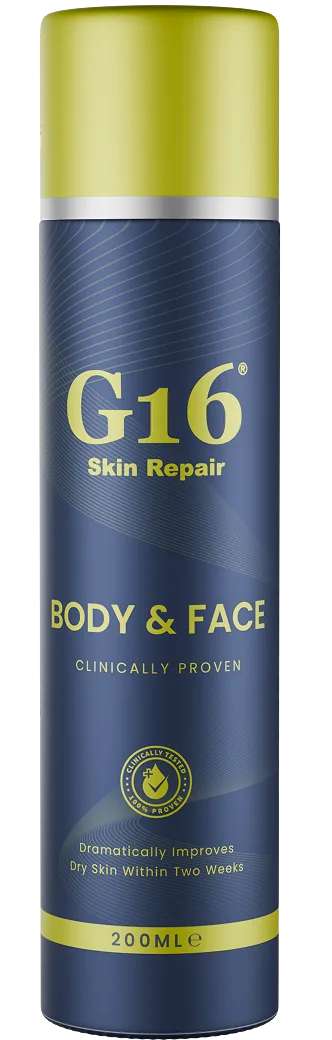
G16 Skin Repair Lotion is a cosmetic moisturiser. Patch test on a small area before first use, keep it away from the eyes and mucous membranes, and keep it out of reach of children. If your skin is broken, bleeding or infected, or if it gets worse rather than better, speak to a GP or a dermatologist.
