


If you are here because a doctor used this phrase last week, or because someone has made a comment about your son’s neck, the two things worth knowing first are these: it is a recognised, named, manageable condition, and it has nothing whatsoever to do with washing.
X-linked ichthyosis is the second most common inherited ichthyosis, and it affects males almost exclusively. It is caused by a missing or faulty STS gene on the X chromosome. Males have only one X, so a single faulty copy produces the condition; females have two, and a working copy on the other X usually compensates, which makes them carriers rather than affected. It occurs in roughly one in 2,000 to one in 6,000 males.
What is going wrong
The STS gene makes an enzyme called steroid sulfatase. One of its jobs in skin is breaking down cholesterol sulfate in the outer layer.
Without it, cholesterol sulfate accumulates. It acts as a kind of glue, holding dead skin cells together so they cannot separate and shed normally. The cells pile up instead, forming scale. So the underlying problem is retention rather than overproduction: the skin is not making too much, it is failing to let go.
That single fact shapes the whole treatment approach.
How it looks and behaves
- Darker scale than ichthyosis vulgaris. Often brown or grey, large, adherent, sometimes described as dirty-looking, which can be distressing and is medically meaningless.
- Where: neck, trunk, and the extensor surfaces of the limbs. The neck is characteristic enough that it is sometimes called "unwashed neck".
- Creases usually spared, as with ichthyosis vulgaris.
- Palms and soles normal, which helps distinguish it from ichthyosis vulgaris, where palm markings are increased.
- Onset early, often in the first weeks or months of life, and it does not usually improve much with age, unlike ichthyosis vulgaris.
- Seasonal: better in humid conditions, worse in winter.
Things worth knowing that go beyond the skin
This is where X-linked ichthyosis differs meaningfully from other forms, and it is worth being aware of even though most of it is uncommon.
- Corneal opacities. Small comma-shaped opacities on the cornea occur in a substantial proportion of affected males and in some carrier females. They usually do not affect vision, but an eye examination is reasonable.
- Undescended testes occur more often than in the general population.
- Delayed labour. Because placental steroid sulfatase is also affected, mothers carrying an affected baby may fail to progress in labour. This is a recognised association and is often how the condition is first suspected.
- Contiguous gene deletions. Where the deletion extends beyond STS to neighbouring genes, there can be additional features. Larger deletions have been associated with a higher rate of attention and learning differences, so a clinical genetics assessment is worthwhile rather than assuming the skin is the whole picture.
None of this is a reason to worry. It is a reason to have the diagnosis confirmed properly by genetics rather than left as "dry skin", so that anything relevant gets looked at.
Treatment
There is no cure, because the gene is unchanged. Management follows the same two-part logic as other ichthyoses, and because the problem here is specifically retention, the keratolytic half carries even more weight than usual.
1. Loosen the retained scale
- Alpha hydroxy acids, glycolic and lactic, which break the bonds holding the retained cells together.
- Urea at 10 to 40 per cent, softening keratin and holding water.
- Salicylic acid, effective but absorbed across large areas, so used cautiously and generally avoided in children.
2. Hold water in
Emollients, generously, and applied within a few minutes of bathing while the skin is damp.
3. Bathe to help
Long warm soaks soften the scale, followed by gentle removal with a washcloth. Never on dry skin, never hard enough to redden. Then moisturise immediately.
4. Humidity
A humidifier through winter, for the same reason it helps every ichthyosis: a leaky barrier loses less water to humid air.
For severe cases
A dermatologist may consider oral retinoids. Effective, with significant side effects, and reserved for cases topical treatment cannot control.
For parents. The dark, adherent scale on a child's neck and trunk often attracts unhelpful comments about washing. It has nothing to do with hygiene: the skin is retaining cells it cannot release. Schools and clubs generally respond well to a short explanation, and the Ichthyosis Support Group in the UK and FIRST in the US both have material written for exactly this.
Where G16 fits, and where it does not
G16 Skin Repair is a keratolytic lotion, glycolic acid alongside lactic acid, which puts it squarely in the first category above. Since X-linked ichthyosis is fundamentally a retention problem, loosening what is being retained is the part that changes how the skin looks, and plain emollients alone characteristically do not achieve it.
The base carries aloe vera, glycerin, panthenol, allantoin and shea butter, so the hydrating half happens alongside.
It is not a cure and cannot be. It is not for broken, bleeding or infected skin. It is not formulated for harlequin ichthyosis. It does nothing about the non-skin features described above, which need their own review. And for a young child, dermatology advice on strength and frequency should come before any acid product.
High-strength urea creams work on the same principle and cost less, and for many families that is the sensible first try.
When to see a doctor
- To get the diagnosis confirmed genetically if it has only ever been called dry skin. This matters here more than in other ichthyoses.
- For an eye examination, given the corneal association.
- If a boy has undescended testes.
- Skin cracked, bleeding or infected.
- Topical treatment is not controlling the scale, for a dermatology referral.
- For genetic counselling regarding carrier status and future pregnancies.
Common questions
Very rarely in the full form. Females have two X chromosomes, so a working copy on the second one usually compensates and they are carriers rather than affected. Some carriers have mild dry skin or corneal opacities. Full expression in a female requires unusual circumstances and is uncommon.
Ichthyosis vulgaris involves the filaggrin gene, affects both sexes, produces finer paler scale mostly on the shins, increases the fine lines on the palms, and often improves with age. X-linked involves the STS gene, affects males, produces darker larger scale on the neck and trunk, leaves the palms normal, and tends not to improve with age.
The scales are larger, thicker and more firmly stuck down than in other ichthyoses, and they stay on the skin far longer than normal cells would. Thicker retained scale reads darker, and it picks up more from the environment while it sits there. It is not dirt and it is not a hygiene issue.
Generally less than ichthyosis vulgaris does. It tends to persist through adulthood, though it fluctuates with the seasons and is usually much better in humid weather. What does change is how well people manage it, and a consistent routine makes a large difference to how it looks day to day.
The product behind this guide
G16 Skin Repair is a glycolic and lactic acid body lotion for built-up, scaly and thickened skin.
200ml. Made in the UK. 21 day money back guarantee.
Ichthyosis treatment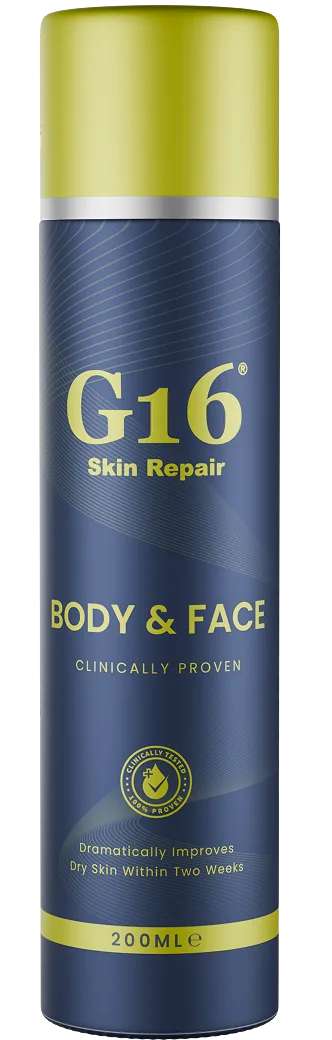
G16 Skin Repair Lotion is a cosmetic moisturiser. Patch test on a small area before first use, keep it away from the eyes and mucous membranes, and keep it out of reach of children. If your skin is broken, bleeding or infected, or if it gets worse rather than better, speak to a GP or a dermatologist.
