


Ichthyosis in children is usually inherited and shows as dry, rough, scaly skin that appears at birth or in the first few years of life. The commonest type, ichthyosis vulgaris, is often mild and starts in early childhood, while rarer types can be obvious from birth. Any baby or child with scaly skin should be seen by a GP or health visitor so the type can be named and care planned.
It is not contagious, it is not caused by anything a parent did, and it is not about washing. Most children with the milder forms lead completely ordinary lives with a good daily skin routine. This page covers the signs at different ages, what happens with a collodion baby, the common inherited types, and the practical side of school and home life.
Signs by age
When ichthyosis shows up is one of the most useful clues to which type it is.
| Age | What you might notice | Often points to |
|---|---|---|
| At birth | Tight, shiny, film-like covering over the whole body | Collodion baby, often lamellar or a related type |
| At birth or first weeks | Red, fragile skin that blisters easily | Epidermolytic ichthyosis |
| First months | Larger, greyish or brown scale in a baby boy, often on the neck and limbs | X-linked ichthyosis |
| Usually after the first year | Fine, pale scale on the shins and outer arms, lined palms | Ichthyosis vulgaris |
| Older child | Rough bumps on upper arms, scale worse in winter | Ichthyosis vulgaris, often with keratosis pilaris |
Many newborns have some peeling skin in the first couple of weeks, especially babies born after their due date. That is normal and settles on its own. Ichthyosis is different because the scale persists or comes back, and often there is a parent or relative with similar skin.
Collodion baby: what happens
A collodion baby is born encased in a tight, shiny, see-through membrane that looks a little like cling film. It is not a diagnosis in itself but a way some inherited ichthyoses first show. The membrane cracks and sheds over the first few weeks, and the skin underneath then reveals which type of ichthyosis it is.
Collodion babies are cared for in hospital, usually on a neonatal unit, because the membrane affects how well the skin controls temperature, holds water and keeps out infection. Care typically involves a humidified incubator, careful monitoring of fluids and temperature, frequent bland emollients, and watching the eyes and mouth, which the tight membrane can pull on. The membrane should be left to come away on its own rather than picked or peeled.
Harlequin ichthyosis, the most severe form, is also seen at birth and needs specialist hospital care from the start. It is rare.
Nothing to buy for this stage. Newborns with ichthyosis are managed entirely by the hospital team, and any products used on their skin should be ones the team has recommended. Acid-based lotions and exfoliants are not suitable for babies.
The common inherited types
- Ichthyosis vulgaris. By far the commonest. Usually mild to moderate, appearing in early childhood, worse in winter and often linked with eczema, asthma or hay fever in the family. Our ichthyosis vulgaris guide covers it in more depth.
- X-linked ichthyosis. Almost always affects boys, passed down through the mother. Scale tends to be larger and darker. Sometimes linked to a slow labour, undescended testes, or attention and learning differences, so it is worth mentioning to the GP. See our X-linked ichthyosis page.
- Lamellar ichthyosis and related types. Rare, often starting as a collodion baby, with large plate-like scale and sometimes tightening around the eyelids. Managed by a dermatology team. Our lamellar ichthyosis page has more.
- Epidermolytic ichthyosis. Rare, with blistering and fragile skin early on that later becomes thick, ridged scale.
The more severe types are usually looked after by a paediatric dermatology service, often with a specialist nurse.
School and daily life
Bathing
- Use lukewarm water and a soap substitute or emollient wash rather than soap or bubble bath.
- A soak helps soften scale; afterwards, pat dry and apply emollient straight away while the skin is still damp.
- Emollient bath products make the bath slippery, so take care getting children in and out.
Overheating
Heavier scale can block sweating, so some children overheat easily during exercise, hot weather or illness. Signs include a flushed face, tiredness and feeling unwell when others are fine. Let the school know, make sure water is always available, allow breaks and shade in PE, and dress your child in layers that can come off.
Swimming
Children with ichthyosis can usually swim. Chlorine is drying, so apply emollient before and after, rinse off well with fresh water, and moisturise again once dry. Some families find swimming softens the scale, which is a bonus.
Clothing
- Soft, breathable cotton next to the skin, and avoid scratchy wool directly on it.
- Layers rather than one thick top, to help with temperature.
- Emollients can mark clothes and bedding, so older soft clothes for overnight are practical.
At school
A short note to the teacher helps: what the condition is, that it is not catching, whether your child needs emollient during the day, and any overheating plan. Some children get questions or teasing about their skin, and a simple explanation they can repeat, such as "my skin makes too many skin cells", often helps.
Support
In the UK, the Ichthyosis Support Group is a charity run for and by families affected by ichthyosis. It offers information on the different types, practical advice on daily care and school, and the chance to connect with other families, including family days. Your GP, dermatology team or specialist nurse can point you to it, and it is easy to find online. Many families say meeting others with the same condition is one of the most helpful things they did.
Where G16 fits, and where it does not
G16 Skin Repair is an adult body lotion containing glycolic and lactic acid, which loosen built-up dead skin, alongside hydrating ingredients. Acid-based lotions such as G16 are not for babies, and children should only use one on the advice of their GP or dermatology team. For babies and young children, bland emollients recommended by a health professional are the right starting point.
For older teenagers and adults with the common forms, G16 is used twice daily on intact skin, with a full course of 28 days. It manages how the skin looks and feels; it does not change the condition. Patch test first, avoid the eyes, do not use on broken, cracked or infected skin, and use sunscreen on exposed areas.
When to see a GP or health visitor
- Any baby or child with scaly skin that persists beyond the normal newborn peeling.
- Red, weeping, blistering or very sore skin, or signs of infection such as heat, spreading redness, yellow crusts or pus.
- A baby who is feeding poorly, not wetting nappies, or seems unusually hot, cold or floppy: seek urgent medical help.
- Your child overheats easily, seems unwell in warm weather, or struggles in PE.
- Scale around the eyes, eyelids turning outwards, or problems with hearing from scale in the ears.
- Itch keeping your child awake, or skin being scratched until it bleeds.
- Your child is upset or being teased about their skin.
Common questions
It depends on the type. Some babies are born with a tight, shiny membrane, known as a collodion baby. Others have red, fragile or blistering skin, or larger greyish scale in the first months. The commonest type, ichthyosis vulgaris, usually does not show until after the first year, as fine scale on the shins and arms. A health visitor or GP should check any scaly skin that persists.
Inherited ichthyosis is lifelong, but it often becomes easier. Ichthyosis vulgaris in particular frequently improves in adulthood and is usually better in summer. With a steady daily routine, most children with the milder forms have skin that is comfortable and not a big part of their lives.
Usually yes. Put emollient on before swimming to protect the skin, rinse well with fresh water afterwards, and moisturise again once dry, because chlorine is drying. If your child has broken or very sore skin, check with the GP first.
Not without medical advice. Acid-based lotions, including G16, are not for babies, and children should only use one if their GP or dermatology team recommends it. Young skin absorbs more of what is put on it, so bland emollients prescribed or suggested by a health professional are the right place to start.
No. It is caused by genes that affect how skin cells are made and shed. Other children cannot catch it from touch, sharing toys or swimming together, and it has nothing to do with hygiene. A short note to school explaining this can save a lot of awkward questions.
The product behind this guide
G16 Skin Repair is a glycolic and lactic acid body lotion for built-up, scaly and thickened skin.
200ml. Made in the UK. 21 day money back guarantee.
Ichthyosis treatment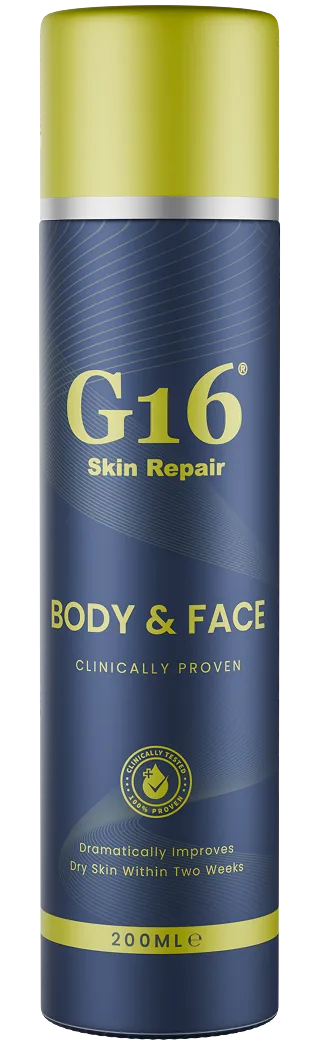
G16 Skin Repair Lotion is a cosmetic moisturiser. Patch test on a small area before first use, keep it away from the eyes and mucous membranes, and keep it out of reach of children. If your skin is broken, bleeding or infected, or if it gets worse rather than better, speak to a GP or a dermatologist.
