



"Crocodile skin" is not a medical diagnosis. It is what people call skin that has dried into visible plates with fine cracked lines between them, most often on the shins. The pattern has two common explanations: severe dryness that has reached the point of cracking, or an inherited shedding disorder called ichthyosis, whose name comes from the Greek for fish precisely because of how it looks. Telling those two apart is the useful thing this page can do, because they need different handling.
What people mean by it
The description usually covers one of these:
- A tiled or plated appearance, where the surface has broken into polygons separated by shallow fissures. Dermatologists call this eczema craquelé or asteatotic eczema when it is dryness-driven, from the French for cracked.
- Defined, adherent scale that looks like overlapping plates rather than loose flakes, typically on the shins, and typically present for years.
- Rough, raised, grid-like texture that catches on clothing and bedding.
The two main causes, and how to tell them apart
| Severe dryness (asteatotic) | Ichthyosis | |
|---|---|---|
| When it started | Adulthood, often later life | Childhood, often before school age |
| Pattern over time | Comes and goes, worse in winter | Constant, though worse in winter |
| Family history | Usually none | Often a parent or sibling with the same skin |
| Where | Shins mainly, sometimes forearms and flanks | Shins, extensor arms, back, sometimes widespread |
| Underlying problem | Water loss and inflammation | Skin does not shed properly, so cells accumulate |
| Responds to | Emollients and removing what strips the skin | Emollients plus something that loosens the build-up |
The distinction that changes what you do. Dryness is a water problem, so putting water back and holding it there fixes it. Ichthyosis is a shedding problem, so hydration alone never quite finishes the job, because the accumulated scale is still sitting on the surface. If you have used good emollients faithfully for weeks and the plates are still there, that pattern itself is informative.
Other things that produce the same look
- Age. Oil production and natural moisturising factors both fall with age, and by the seventies this degree of dryness on the shins is very common.
- Hypothyroidism, which classically produces dry, coarse skin alongside fatigue and cold intolerance.
- Kidney disease, particularly in people on dialysis.
- Diuretics and statins, among other medications.
- Winter, which is why so many people notice it between November and March and assume it has appeared from nowhere.
- Poor circulation in the lower legs, where dryness sits alongside swelling and skin colour change and needs assessment in its own right.
What helps
- Stop stripping it. Shorter, cooler showers. A non-soap cleanser. Pat dry rather than rub.
- Emollient generously and often, ideally within three minutes of bathing while the skin still holds water. This is the foundation and nothing else substitutes for it.
- Raise indoor humidity if the problem is clearly seasonal.
- Treat any medical cause. Skin driven by an untreated thyroid problem improves when the thyroid is treated and not much before.
- Add a keratolytic if defined scale persists despite all of the above, because that persistence points to build-up rather than simple dryness.
What a week of proper care actually looks like
People often say they have tried everything, and on questioning it turns out they applied a cream twice and gave up. Skin on the shins turns over slowly and needs a fair trial. This is what one looks like.
- Every shower: warm rather than hot, five minutes rather than fifteen, non-soap cleanser, and pat dry so the skin is left slightly damp.
- Within three minutes of getting out: apply while the skin still holds water. This single detail changes how much of the product does anything.
- Again before bed, because overnight is when skin repairs and when there is nothing rubbing it off.
- Cotton rather than wool next to the shins while it settles, since wool fibres catch on raised scale and pull it.
- Give it three weeks before judging. Two applications and a verdict is not a trial.
If the legs feel better but look identical after three consistent weeks, that is genuinely useful information rather than a failure. It points at retention rather than dryness, and it changes what you should reach for next.
Where G16 fits, and where it does not
If the shins are tight and rough but there is no real scale to remove, G16 is not the right tool and a plain emollient will do more for less money. That is the honest answer for a lot of people who arrive at this phrase in winter.
Where it becomes relevant is the version with defined, adherent scale that has not shifted with emollients, and the version that turns out to be an ichthyosis. The glycolic and lactic acid loosen accumulated dead skin so it comes away, while aloe vera, glycerin, panthenol, vitamin E and shea butter hydrate the layer underneath.
Applied twice daily, the process starts in the first week, there is usually a flaky phase around day five to seven as loosened scale lifts, and a visible difference typically appears within the first two weeks. The full course is 28 days and more established scaling can take up to about six weeks. Shins are slower than arms.
Where it should not go: skin that is cracked open, bleeding, actively inflamed or infected, which describes asteatotic eczema in its angry phase. Treat the inflammation first. It also will not correct a thyroid problem, a kidney problem, a circulation problem or a medication effect, and none of those should be managed with a lotion.
When to see a doctor
- Cracks that are deep, painful or bleeding, or any sign of infection such as spreading redness, warmth, swelling or pus.
- Skin that appeared suddenly in adulthood with no seasonal or environmental explanation.
- Alongside fatigue, weight change, cold intolerance, thirst or swollen ankles.
- Swelling, aching or colour change in the lower legs, which points at circulation rather than dryness.
- Skin like this since childhood, which is worth having named properly rather than treated as neglect.
- No meaningful change after several weeks of consistent emollient use.
Common questions
No, it is a description rather than a diagnosis. What people are describing is usually one of two things: severe dryness that has cracked into a tiled pattern, which doctors call asteatotic eczema or eczema craquelé, or an inherited shedding condition called ichthyosis. Those need different approaches, so it is worth working out which one you are looking at.
The shins have very few oil glands, thin skin over bone with little underlying fat, and relatively modest blood supply compared with the thigh. They are also the area most exposed to hot water running down in the shower. That combination makes them the first place dryness shows and the last place it resolves.
Not necessarily, and in adults appearing for the first time it usually does not. The pattern that points towards ichthyosis is skin that has been like this since childhood, is present all year rather than only in winter, and often runs in the family. Skin that first appeared in your fifties during a cold snap is far more likely to be severe dryness.
That depends on the cause. If it was driven by winter air, hot showers and harsh soap, it stays away as long as those things stay changed, and tends to return each winter if they do not. If the underlying cause is an inherited shedding condition, it is managed rather than cured, so it needs ongoing maintenance rather than a one-off fix.
The product behind this guide
G16 Skin Repair is a glycolic and lactic acid body lotion for built-up, scaly and thickened skin.
200ml. Made in the UK. 21 day money back guarantee.
Dry skin treatment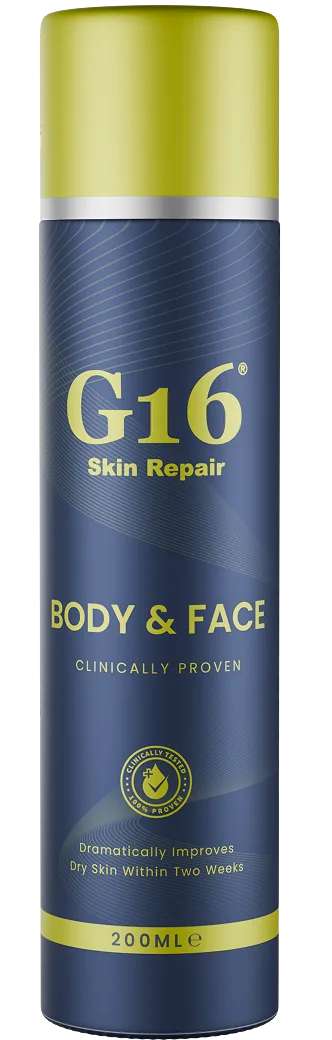
G16 Skin Repair Lotion is a cosmetic moisturiser. Patch test on a small area before first use, keep it away from the eyes and mucous membranes, and keep it out of reach of children. If your skin is broken, bleeding or infected, or if it gets worse rather than better, speak to a GP or a dermatologist.
