


G16 Skin Repair
Glycolic + lactic acid
Two AHAs
Best for
Heavy scale that keeps coming back
Buying it
Direct from us, or Amazon
Honest comparison
Four products, four different acids, four different jobs. Here is what is actually in each one, what it does to built-up dead skin, and which of them we would tell you to buy first — including when that is not us.
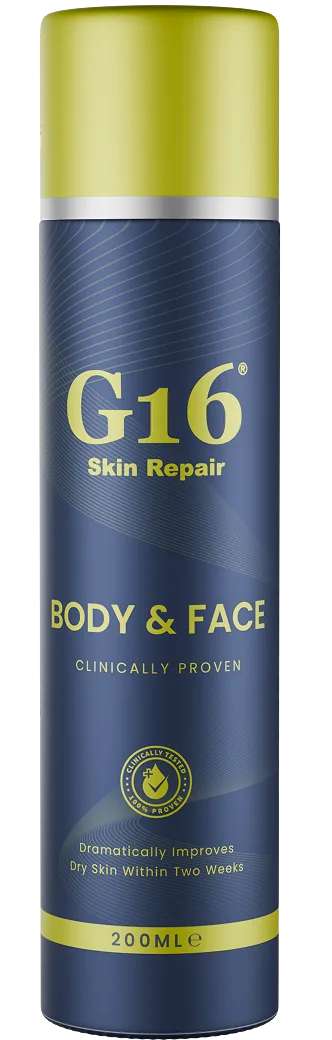
G16 Skin Repair
Glycolic + lactic acid
Two AHAs
AmLactin
Lactic acid
One AHA
Urea creams
Urea, 5–25%
Humectant
CeraVe SA
Salicylic acid
BHA
comparison
All four soften rough, scaly skin, but they do it with different active ingredients. G16 Skin Repair uses two alpha hydroxy acids, glycolic acid (hydroxyacetic acid) and lactic acid. AmLactin uses lactic acid on its own, as ammonium lactate. Urea creams use urea, which draws water into the skin and loosens dead skin at higher strengths. CeraVe SA uses salicylic acid, alongside ceramides. The SA in the name is the salicylic acid, which is a beta hydroxy acid, or BHA.
The short version: urea creams and CeraVe SA are cheap, easy to buy and good general-purpose options for rough skin. AmLactin is the closest comparison to G16 but uses one acid instead of two and is easier to find in the United States than in the UK. G16 is the most expensive of the four and is the one people tend to arrive at after the others have not shifted heavy scale.
| G16 Skin Repair | AmLactin | Urea creams | CeraVe SA | |
|---|---|---|---|---|
| Active ingredients | Glycolic acid + lactic acid (two AHAs) | Lactic acid as ammonium lactate (one AHA) | Urea, typically 5–25% | Salicylic acid (BHA) + ceramides |
| Main job | Lifts built-up dead skin, then hydrates underneath | Exfoliates and hydrates | Holds water in the skin; loosens dead skin at higher strengths | Smooths bumps and refines texture |
| Usually chosen for | Ichthyosis, hyperkeratosis, heavy scale, thickened skin | Rough, dry, bumpy skin; keratosis pilaris | Very dry skin, cracked heels, general maintenance | Keratosis pilaris, bumpy arms and legs |
| Texture | Light lotion, non-greasy, absorbs quickly | Lotion or cream | Cream to ointment, can be heavy | Light cream |
| Where to buy in the UK | Direct from us and Amazon.co.uk | Limited UK stock, mostly imported | Any pharmacy or supermarket | Any pharmacy or supermarket |
| Price | The most expensive of the four | Mid | Lowest | Low to mid |
| Money-back guarantee | 21 days, direct from us | Retailer dependent | Retailer dependent | Retailer dependent |
Competitor details are taken from each brand’s own published ingredient lists. Formulations and prices change, so check the pack before you buy.
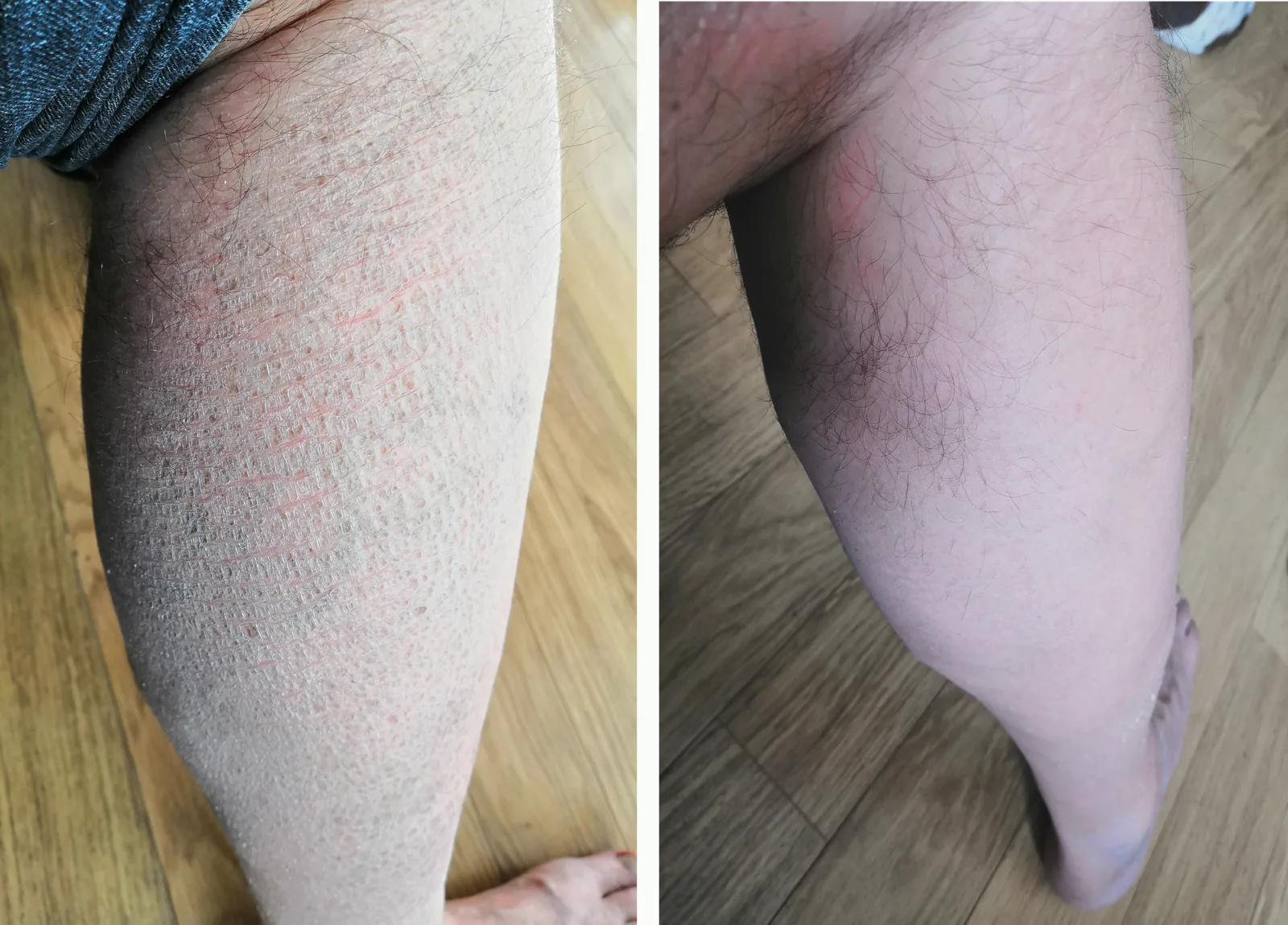
Same leg
Every product on this page softens dry skin. The question is whether it removes the built-up scale or just sits on top of it. That is the whole comparison, and it is easier to see than to describe.
Customer photograph, unretouched. Individual results vary, and the 28-day course is what the results are based on.
AmLactin is the closest product to G16 on this list. Both are acid-based body lotions rather than plain moisturisers, and both aim to remove dead skin rather than sit on top of it. The difference is the acid. AmLactin relies on lactic acid alone. G16 leads with glycolic acid, the smallest of the alpha hydroxy acids, and adds lactic acid behind it. Glycolic acid is the second ingredient in G16 after water.
In practice that matters most on thick, built-up scale, which is where people with ichthyosis and hyperkeratosis tend to get stuck. If your skin is dry and a little rough, AmLactin may well be enough, and it is cheaper. If you have visible plates or fish-scale patches that other lotions soften but never clear, that is the situation G16 was formulated for.
The practical point for UK buyers is availability. AmLactin is an American brand and UK stock is inconsistent, often imported at a markup with long delivery times.
Urea does two different jobs depending on how much of it is in the tube. At low strengths, roughly 5 to 10 per cent, it is a humectant: it pulls water into the skin and keeps it there. At higher strengths, roughly 20 to 40 per cent, it also breaks down keratin and loosens dead skin.
Urea creams are inexpensive, available in any pharmacy, and genuinely good at keeping skin comfortable day to day. Many people use one alongside G16 rather than instead of it. Where they differ is mechanism: urea mostly softens and hydrates the scale, while the acids in G16 work to release it so it comes away. Urea creams are also often thicker and greasier, which is why some people will not use them in the morning.
If cost is the deciding factor, a urea cream is the sensible first thing to try. G16 is worth considering when you have tried one properly and the scale keeps coming back.
CeraVe label several products “SA”, and the letters stand for salicylic acid. The two you will see most are the SA Smoothing Cream and the SA Cream for Rough & Bumpy Skin. Salicylic acid is a beta hydroxy acid. The important practical difference from an AHA is that salicylic acid is oil-soluble, so it works into the pore. That makes it a strong choice for keratosis pilaris, the small rough bumps on the backs of the arms and thighs, and it is cheap and easy to buy. CeraVe also includes ceramides, which help the skin barrier.
For keratosis pilaris specifically, CeraVe SA is a reasonable and much cheaper starting point. For heavy, sheet-like scale on the legs, shins and torso, an AHA-led lotion is generally the better fit, which is what G16 is.
“I have been battling ichthyosis vulgaris my entire life and have tried everything under the sun. So far this is the best I have found.”
Verified review of G16 Skin Repair · Trustpilot
It is a fair question, and one customers raise. A 7 per cent glycolic toner costs under £10, and if you moisturise on top you have an acid and a moisturiser for a fraction of the price. For mild roughness that combination can work.
Two things make it different from G16. First, a toner is a thin water-based liquid designed for the face, so covering a whole body with it is awkward and gets expensive faster than the sticker price suggests. Second, G16 is a single lotion that stays on the skin: glycolic and lactic acid in a base with aloe vera, glycerin, panthenol, allantoin and shea butter, so the hydration is delivered at the same time rather than layered on afterwards. It is designed to be left on for as long as possible, ideally around ten hours, which a toner is not.
If a cheap toner and a moisturiser are working for you, keep using them. G16 exists for the people that has not worked for.
G16 is the most expensive product on this page and we are not going to pretend otherwise. It is a small company making a lotion in the UK in a heavily regulated category, and there has been one price increase in the last eight to ten years.
Three things are worth knowing before you judge the cost. The first is that headline price is a poor way to compare skincare, because pack sizes across this category vary enormously. G16 is a 200ml bottle. A good deal of what is sold for dry and thickened skin comes in 50ml pots, where a lower shelf price can still work out at several times the cost per millilitre. It is worth checking the size on whatever you are comparing.
The second is that you use the most in the first few weeks, while the built-up skin is coming away. Once skin is where you want it, most people drop to once a day, every other day, or a week on and a week off, which brings the running cost down a long way.
The third is the 21-day money-back guarantee when you buy direct, so if it does nothing for you, you are not stuck with it.
testimonial
Real reviews, published on Trustpilot, quoted as written. G16 Skin Repair is rated 4.1 out of 5 from 112 Trustpilot reviews and 3.7 out of 5 from 355 ratings on Amazon.co.uk.

“I am 65 years old and have dealt with my skin my entire life! Using prescription lotion, over the counter lotion, all that just helped some with the dryness, none that actually took the scales away. G16 is that product that took the scales away and made my skin so soft, like normal skin.”
“I have been battling ichthyosis vulgaris my entire life and have tried everything under the sun. So far this is the best I have found. I just wish that either it came in bigger bottles or lower price.”
“It is expensive but it is the only cream on the market that has helped my condition of ichthyosis vulgaris. Just be patient with it.”
“After trying other creams I found G16 It was far better than all the other creams it left my skin nice and smooth and not greasy I thoroughly recommend this product”
“I’ve bought five times on Amazon for this product, and it works great. if you follow the instructions, the dead skin will peel off, and work much better than other products on the market”
Read every review on Trustpilot, including the critical ones.
Mild dryness and rough patches. Start with a urea cream. It is the cheapest thing that works and you can buy it today.
Keratosis pilaris, bumps on arms and thighs. CeraVe SA is a sensible, low-cost first try. If the bumps persist, an AHA lotion is the next step.
Rough, dry, slightly bumpy skin, and you are in the United States. AmLactin is easy to get and cheaper than G16.
Ichthyosis, hyperkeratosis, thick scale that keeps returning. This is what G16 is formulated for, and it is where most of our customers come from after trying the others.
Yes. Many people use G16 as the active step and a plain moisturiser or urea cream for comfort in between. Apply G16 to completely dry skin and leave it on as long as you can, ideally around ten hours, before layering anything else on top.
They do the same kind of job in different ways. Glycolic acid has the smallest molecule of the alpha hydroxy acids, so it penetrates readily, which is useful on thickened skin. Lactic acid is gentler and holds more water in the skin. G16 uses both rather than choosing between them.
G16 Skin Repair is made in the UK and ships from the UK, and it is the closest equivalent in category: an acid-based body lotion rather than a plain moisturiser. It uses glycolic acid alongside lactic acid, where AmLactin uses lactic acid alone. Urea creams such as Eucerin UreaRepair and Balneum are widely stocked in UK pharmacies and are a cheaper alternative if cost matters more than clearing heavy scale.
G16 is used twice daily for 28 days. Many customers report a visible change within the first two weeks, but the 28-day course is what the results are based on, and the 21-day money-back guarantee is there so you can judge it for yourself.
It is made in small batches in the UK by a small company, in a category with high regulatory and testing costs, and the price has risen once in the last eight to ten years. Usage also drops once the built-up skin has cleared, so the ongoing cost is lower than the first bottle suggests.
G16 Skin Repair Lotion is a glycolic acid (hydroxyacetic acid) and lactic acid body lotion for ichthyosis, ichthyosis vulgaris, keratosis pilaris, hyperkeratosis and thickened, scaly, flaky or rough skin. Applied twice daily for 28 days, it lifts built-up dead skin and restores hydration underneath.
G16 Skin Repair Lotion is a cosmetic moisturiser. Patch test on a small area before first use, keep it away from the eyes and mucous membranes, and keep it out of reach of children. If your skin is broken, bleeding or infected, or if it gets worse rather than better, speak to a GP or a dermatologist.
Join our newsletter to stay up to date on offers and releases.
