



If you have ichthyosis vulgaris you have almost certainly been told to "just moisturise more", usually by someone who has never had to think about what they wear in summer. It is not bad advice. It is half the advice, and the missing half is why nothing has ever quite worked.
The condition itself cannot be cured. It is caused by a change in a gene you were born with and nothing available today alters that. But it can be controlled well enough that your skin looks and feels close to normal for most of the year, and that is a realistic goal rather than a sales pitch.
What is going wrong in the skin
The gene involved is filaggrin. It does two jobs: it binds keratin filaments together to build a proper skin barrier, and as it breaks down it produces the natural moisturising factors that hold water in the outer layer.
With less working filaggrin, two things follow. The barrier leaks, so the skin dries out faster than it should. And the dead cells at the surface do not release cleanly, so instead of shedding invisibly they accumulate into scale.
That second part is the bit that matters for treatment. The problem is not only that the skin is dry. It is that it will not let go of dead cells. This is why plain moisturisers, however rich, only ever half work.
How it presents
- Fine white, grey or brown scale, most often on the shins and the outer upper arms.
- Scale that has a plate-like or cracked-paving look, sometimes described as fish scale.
- Skin creases at the elbows, knees, armpits and groin usually spared.
- Very fine lines and increased markings on the palms and soles.
- Frequently alongside keratosis pilaris on the arms, and often with an atopic tendency: eczema, asthma or hay fever.
- Clearly better in humid weather and worse in winter. Many people find summer holidays near the sea almost clear it.
It usually appears in the first few years of life, often after the first birthday, and it commonly improves somewhat in adulthood.
The treatment that actually works
Dermatology guidance for ichthyosis converges on the same two-part approach. You need both halves.
1. Keratolytics, to remove the scale
These loosen the bonds holding the dead cells together so the build-up releases.
- Alpha hydroxy acids. Glycolic acid and lactic acid. Lactic acid is well established in ichthyosis specifically and has the advantage of being humectant as well, so it hydrates while it exfoliates. Glycolic acid has the smallest molecule of the AHAs, which is useful on thickened skin.
- Urea, typically 10 to 40 per cent. At the higher end it breaks down keratin as well as holding water. Widely available and inexpensive.
- Salicylic acid. Effective, but it can be absorbed through large areas of skin, so it is generally avoided over big surfaces and in children.
- Propylene glycol preparations, sometimes prescribed.
2. Emollients, to hold water in
Applied generously and often, ideally within a few minutes of bathing while the skin is still damp. This is the unglamorous half and skipping it is the most common reason people say nothing works.
3. Bathing that helps rather than hinders
- Regular baths soften scale and make removal easier. Ten to twenty minutes, comfortably warm rather than hot.
- A non-soap cleanser. Ordinary soap strips what little barrier there is.
- Gentle mechanical removal after soaking, with a washcloth or a soft brush. Never on dry skin, never hard enough to redden.
- Pat dry and moisturise immediately.
4. Humidity
A humidifier through the winter is one of the highest-value, lowest-cost interventions available for this condition.
For severe cases
Oral retinoids such as acitretin can be prescribed by a dermatologist for severe ichthyosis. They are effective and carry significant side effects, including being seriously harmful in pregnancy, so they are reserved for cases that topical treatment cannot control.
A note on expectations. The realistic aim is soft, comfortable skin with minimal visible scale, maintained by an ongoing routine. It is not a course you finish. Most people find they can reduce how much they use once the built-up scale has cleared, but stopping altogether means it returns over a few weeks.
Living with it
- Winter needs a different routine from summer. Plan for it rather than being surprised annually.
- Overheating and sweating can be uncomfortable, because scale interferes with normal sweating. Take care in hot weather and during exercise.
- Swimming pools dry the skin badly. Rinse and moisturise straight after.
- It is genetic, so there is a reasonable chance of passing it on. A genetics service can explain the pattern properly if that matters to you.
- Support exists. The Ichthyosis Support Group in the UK and FIRST in the US are both worth knowing about.
Where G16 fits, and where it does not
G16 Skin Repair is built for exactly the first half of the approach above. It leads with glycolic acid alongside lactic acid, the two AHAs most used for ichthyosis, in a base with aloe vera, glycerin, panthenol, allantoin and shea butter so the emollient half happens at the same time. It is applied twice daily for 28 days, then reduced.
It suits the scale itself, which is the part that plain moisturisers do not shift.
It is not a cure and cannot be, because the gene is unchanged. It is not for broken, bleeding or infected skin. It is not formulated for harlequin ichthyosis. And it does not replace the emollient habit: on very dry days most people will still want something plain on top.
A high-strength urea cream from a pharmacy works on the same principle and costs less. Whether the difference is worth it to you is a fair question, and the 21-day money-back guarantee exists so you can find out without committing.
When to see a doctor
- The skin is cracked and bleeding, or shows signs of infection.
- Scale is thick enough to restrict movement at joints.
- There is significant itch affecting sleep.
- A newborn or infant has severe scaling, which needs specialist assessment.
- Topical treatment is not controlling it, in which case a dermatology referral is reasonable.
- The scaling started suddenly in adulthood. Acquired ichthyosis is uncommon but can be associated with thyroid disease, kidney disease, some medications and occasionally malignancy, so it should be investigated.
Common questions
No. It is caused by an inherited change in the filaggrin gene and no treatment alters that. It can be controlled well enough that the skin looks and feels close to normal, but it is a management routine rather than a cure, and it returns if treatment stops.
Humidity. A leaky skin barrier loses water to the air, and humid air pulls far less out. Many people with ichthyosis vulgaris find their skin nearly clears near the sea and deteriorates as soon as the heating goes on. A humidifier through winter is the closest you can get to importing that effect.
No, and the difference matters for treatment. Ordinary dry skin is short of water and oil. Ichthyosis vulgaris additionally fails to shed dead cells properly, so they accumulate as scale. That is why moisturiser alone helps but never quite resolves it, and why something that loosens the build-up is needed alongside.
There is a meaningful chance, since it is inherited in a dominant pattern, though severity varies a great deal between family members and some carriers have skin so mild it is never noticed. A clinical genetics service can explain the specific odds for your family, which is a better source than any website.
With a keratolytic used twice daily, most people see a visible difference within the first two weeks. Clearing long-established scale properly takes around 28 days, and severe or long-standing cases can take up to about six weeks. After that most people can reduce frequency to maintain it.
The product behind this guide
G16 Skin Repair is a glycolic and lactic acid body lotion for built-up, scaly and thickened skin.
200ml. Made in the UK. 21 day money back guarantee.
Ichthyosis treatment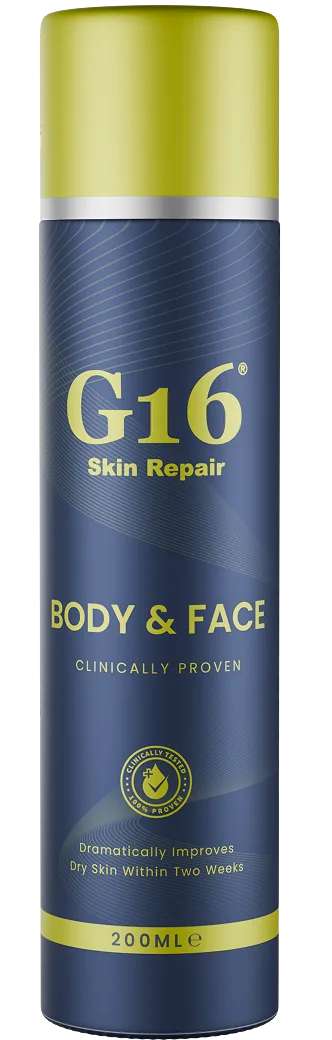
G16 Skin Repair Lotion is a cosmetic moisturiser. Patch test on a small area before first use, keep it away from the eyes and mucous membranes, and keep it out of reach of children. If your skin is broken, bleeding or infected, or if it gets worse rather than better, speak to a GP or a dermatologist.
