



Dry skin on the face is most often caused by cold weather, central heating, harsh cleansers and over-use of active skincare such as retinoids and exfoliating acids, all of which strip the oils that hold water in the skin. Gentler cleansing, a simple moisturiser applied twice a day and fewer actives usually settle it within two to three weeks. Scaly, flaky or thickened patches that keep coming back in the same place are different, and often point to seborrhoeic dermatitis, perioral dermatitis or, in older adults, sun damage worth showing to a GP.
Facial skin is thinner than skin on the body, more exposed to weather, and gets more products put on it than anywhere else. The cause of a dry face is very often something in the bathroom cabinet rather than the skin itself.
Common causes of a dry, flaky face
Weather and heating
Cold outdoor air holds little moisture, wind strips it from the surface, and indoor heating dries the air further. Cheeks, the nose and the area around the mouth are usually first to feel tight. It tends to be even across the face rather than in defined patches. Our guide to dry skin in winter covers the seasonal side in more detail.
Cleansers and hot water
Foaming face washes, bar soap and very hot water remove the lipids that keep the skin barrier sealed. If your face feels tight after washing, the cleanser is too strong. Switching to a cream or non-foaming cleanser and lukewarm water is often the single most useful change.
Retinoids and acids
Retinol, prescription retinoids such as tretinoin and adapalene, and exfoliating acids all speed up how quickly skin cells turn over. In the first weeks, or when used too often, they cause peeling, redness and stinging. Layering several actives at once is a common reason for a sudden dry, sore face.
Seborrhoeic dermatitis
This produces red or pink patches with greasy, yellowish or white flakes, typically along the sides of the nose, in the eyebrows, between the brows, around the hairline and behind the ears. It often comes with dandruff. It is linked to a yeast that lives on normal skin. Moisturiser alone rarely clears it; antifungal creams are the usual first step, and a pharmacist can advise.
Perioral dermatitis
Small red bumps and dry, flaky skin around the mouth, sometimes spreading to the sides of the nose and around the eyes, with a clear band of normal skin right next to the lips. Steroid creams and heavy face creams are common triggers, and it tends to get worse with more moisturiser. It needs a GP rather than skincare.
Actinic keratosis: a GP flag
In people over about 40 with a history of sun exposure, a rough, scaly, red or skin-coloured patch that feels like sandpaper and keeps returning in the same spot may be an actinic keratosis. These are caused by long-term sun damage and usually appear on the forehead, nose, cheeks, ears or scalp. They are common and not cancer, but a small number can change over time, so get any persistent scaly patch checked.
| What you see | Where on the face | Likely cause |
|---|---|---|
| Even tightness, fine flaking | Cheeks, nose, chin | Weather, heating or a harsh cleanser |
| Peeling and stinging after new products | Wherever the product goes | Retinoid or acid irritation |
| Red patches with greasy yellow or white flakes | Sides of nose, eyebrows, hairline | Seborrhoeic dermatitis |
| Tiny red bumps and flaking, clear band by the lips | Around the mouth and nose | Perioral dermatitis |
| Rough, sandpapery scaly patch that keeps returning | Forehead, nose, cheeks, ears | Possible actinic keratosis |
| Itchy, red, dry patches, sometimes on eyelids | Eyelids, cheeks, neck | Eczema or contact dermatitis |
| Crusty, weeping or golden crusted patches | Around nose and mouth | Possible infection such as impetigo |
Scaly, crusty or thickened patches
When facial dryness becomes scaly, crusty or thicker, something else is usually going on.
- Dry scaly patches on the face that are red and greasy point towards seborrhoeic dermatitis. Dry, matt and itchy points more towards eczema.
- A single red scaly patch that does not clear with moisturiser in a few weeks, or keeps coming back in the same spot, should be seen by a GP, especially on sun-exposed skin.
- Crusty patches that weep or form a honey-coloured crust, particularly around the nose and mouth, may be impetigo, a bacterial infection that spreads easily and needs treatment.
- Skin thickening on the face can follow long-term rubbing or scratching, which makes the skin leathery and more lined. Rosacea can also slowly thicken the nose. Both need a GP, not a stronger exfoliant.
For scaly patches elsewhere on the body, see our guide to scaly patches on skin.
More products is rarely the answer. When the face is dry and sore, the instinct is to add a serum, an oil and a mask. The faster fix is usually three steps for two weeks: gentle cleanser, plain moisturiser, sunscreen. Then reintroduce actives one at a time.
A simple routine for a dry face
- Cleanse once a day with a cream or non-foaming cleanser and lukewarm water. Pat dry rather than rubbing.
- Moisturise within a minute or two of washing, while the skin is still slightly damp.
- Choose a fragrance-free moisturiser with glycerin, ceramides or hyaluronic acid.
- Wear sunscreen every day, SPF 30 or higher, even in winter.
- Pause retinoids and acids while the skin is sore, then bring them back slowly, two or three nights a week.
Face-safe actives, and how to use them
Once the barrier has settled, a few actives help with roughness and flaking if used sparingly.
- Glycerin, ceramides and hyaluronic acid draw in and hold water. These are the base of any good dry skin moisturiser and suit almost everyone.
- Lactic acid is a gentle AHA that loosens dead skin while also helping the skin hold water. It is usually better tolerated on the face than glycolic acid.
- Glycolic acid is stronger and works faster, but is more likely to sting on dry or sensitive facial skin. Our lactic acid vs glycolic acid guide explains the difference.
- Low-strength urea, around 5 per cent, hydrates and softens flaking.
Keep exfoliating actives away from the eyes and lips, use them on intact skin only, and pair them with daily sunscreen. For many people, a plain, inexpensive pharmacy moisturiser is all that is needed.
Where G16 fits, and where it does not
G16 Skin Repair is a light, non-greasy body lotion with glycolic acid as its second ingredient and lactic acid behind it, alongside aloe vera, glycerin, panthenol, allantoin, vitamin E and shea butter. It loosens built-up dead skin so it lifts away while hydrating underneath. It is designed mainly for the body, and it is not a face cream.
On the face, it can suit rough, flaky build-up on intact skin that a plain moisturiser has not changed. Because facial skin is thinner, anyone using it on the face for the first time, anyone with sensitive skin, and children under 10 are advised to dilute it, mixing 50ml of a regular aloe moisturiser cream per 100ml of G16. Avoid the eye area completely, patch test first, and use sunscreen every day, as AHAs increase sun sensitivity.
Where it does not belong: on face skin that is red, raw, inflamed, cracked or crusty, or on any patch you have not had checked. For ordinary winter dryness, a gentle cleanser and a simple moisturiser will do the job for far less money, and G16 is the most expensive option compared with pharmacy creams.
When to see a GP
- A rough, scaly or red patch that keeps returning in the same place, especially on sun-exposed skin.
- Red, flaky patches with greasy scale around the nose, brows or hairline that do not respond to pharmacy treatment.
- Small red bumps and flaking around the mouth or nose.
- Crusting, weeping or honey-coloured crusts, which may be infection.
- Skin that is thickening, changing colour, bleeding or growing.
- Dry, scaly skin on the face of a baby or young child. Ask a GP or health visitor.
Common questions
Often because something else in the routine is stripping it faster, such as a foaming cleanser, hot water, a retinoid or an acid. Strip the routine back for two weeks. Red, greasy flaking around the nose and brows may be seborrhoeic dermatitis.
The common causes are seborrhoeic dermatitis, eczema, contact dermatitis and irritation from skincare. In older adults, a rough patch that keeps coming back on sun-exposed skin can be an actinic keratosis. Any patch that does not clear within a few weeks is worth showing to a GP.
Not while it is red or sore. Settle it first with a gentle routine. Once calm, a mild acid such as lactic acid two or three times a week can lift lingering flakes. Avoid gritty scrubs, which tear at already dry facial skin.
Repeated rubbing or scratching can make facial skin leathery, long-term sun damage can make it rough and thick, and rosacea can slowly thicken the nose. These need a GP.
A plain, fragrance-free body lotion is usually fine. Acid-based body lotions are stronger than most face products, so dilute them, keep them away from the eyes, patch test first and use daily sunscreen. If in doubt, use a moisturiser made for the face.
The product behind this guide
G16 Skin Repair is a glycolic and lactic acid body lotion for built-up, scaly and thickened skin.
200ml. Made in the UK. 21 day money back guarantee.
Dry skin treatment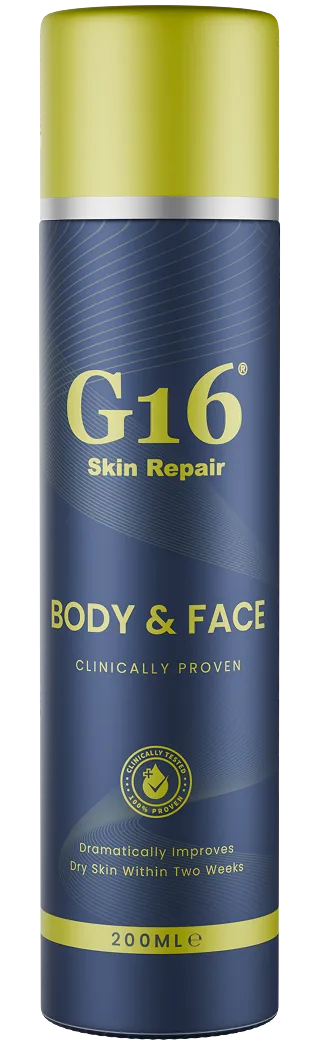
G16 Skin Repair Lotion is a cosmetic moisturiser. Patch test on a small area before first use, keep it away from the eyes and mucous membranes, and keep it out of reach of children. If your skin is broken, bleeding or infected, or if it gets worse rather than better, speak to a GP or a dermatologist.
