



Scaly patches are the skin shedding visibly instead of invisibly. Normally the outer layer sheds a cell at a time and you never notice. When cells stick together and come away in sheets, or when they accumulate faster than they leave, you get a patch you can see and feel. The pattern, the location and whether the patch is flat or raised tell you a great deal about which of several very different causes you are dealing with.
This page is about telling them apart, because they need genuinely different treatment and the commonest mistake is treating one as another.
Start with the pattern
| What you see | Where | Likely |
|---|---|---|
| Fine, flat, dry scale | Shins, forearms, all over | Ordinary dryness or ichthyosis |
| Thick, raised, well-defined plaques with silvery scale | Elbows, knees, scalp, lower back | Psoriasis |
| Red, itchy, sometimes weeping or crusted | Creases of elbows and knees, hands, face | Eczema |
| Round or oval, single or few, slowly enlarging with a raised edge | Anywhere, often trunk | Fungal, sometimes other causes |
| Greasy yellowish scale on red skin | Scalp, eyebrows, sides of nose, chest | Seborrhoeic dermatitis |
| Small rough bumps around hair follicles | Upper arms, thighs, cheeks | Keratosis pilaris |
| Rough, scaly, persistent, in a sun-exposed spot | Face, scalp, forearms, hands | Needs a doctor, see below |
The distinction that matters most
Underneath all of that, there are two mechanisms.
Too little water. The outer layer has dried out and lost flexibility, so it flakes. Put water back, stop stripping it, and it settles. This is most scaly skin, most of the time.
Too little shedding. The skin makes cells normally but does not release them properly, so they accumulate into scale. Adding water softens the pile without removing it. This is what happens in ichthyosis and in areas of chronically thickened skin.
How to tell, without a microscope. Moisturise the area properly for two to three weeks. Water-loss scaling improves substantially. Retention scaling feels softer but looks much the same, and the scale is back within a day of each application. That single observation is worth more than any product recommendation.
Patches you should not self-treat
Most scaly patches are benign. A few are not, and they are worth knowing by description.
- A rough, scaly, sandpapery patch in a sun-exposed area that does not resolve, in someone middle-aged or older. Actinic keratoses are sun damage and are assessed and treated by a clinician, not with moisturiser.
- A single scaly patch that is growing, bleeding, ulcerating or crusting repeatedly, particularly if it never fully heals.
- A scaly patch that keeps returning in exactly the same place for no clear reason.
- Any patch that changes shape, colour or thickness over weeks.
None of that is common, and describing it is not intended to alarm. It is here because a page about scaly patches that omitted it would be doing you a disservice.
What helps ordinary scaling
- Reduce what strips the skin. Cooler, shorter showers, non-soap cleanser, pat dry rather than rub.
- Moisturise while damp, within about three minutes of drying, twice daily.
- Raise indoor humidity if the problem is seasonal.
- Match the treatment to the cause. Fungal patches need an antifungal. Inflamed patches need something anti-inflammatory. Neither is fixed by exfoliating, and exfoliating inflamed skin usually makes it worse.
- Add a keratolytic only where the problem is retained build-up that has not shifted with hydration.
How long each cause takes to respond
Knowing the expected timescale stops people abandoning something that was working, and stops them persisting with something that was never going to.
| Cause | Reasonable trial | What improvement looks like |
|---|---|---|
| Simple dryness | 1 to 2 weeks | Marked change in feel and appearance |
| Retained build-up | 4 weeks, up to about 6 for heavy scale | Gradual thinning, often a flakier phase first |
| Fungal | 2 to 4 weeks of antifungal | Edge stops advancing, then clears inward |
| Seborrhoeic dermatitis | 2 to 4 weeks of antifungal shampoo or cream | Redness and greasy scale both settle |
| Inflammatory | Days once correctly treated | Redness and itch settle before scale does |
The pattern worth noticing: if four weeks of a sensible approach produces nothing at all, the working assumption about the cause is probably wrong, and the answer is to reconsider rather than to apply more of the same.
Where G16 fits, and where it does not
G16 addresses one of the mechanisms above and not the others. Its glycolic and lactic acid loosen accumulated dead skin so it comes away, with aloe vera, glycerin, panthenol, vitamin E and shea butter hydrating underneath. That makes it relevant to retention scaling: thickened, adherent, dry scale that has not responded to weeks of proper moisturising.
Used twice daily, the process starts in the first week, there is often a flakier phase around day five to seven as loosened scale lifts, and a visible difference usually appears within the first two weeks. The full course is 28 days and heavier build-up can take up to about six weeks.
It is the wrong choice for: patches that are inflamed, red, weeping or crusted. Fungal patches, which need an antifungal and will spread if treated as dryness. Seborrhoeic dermatitis. Skin that is broken or infected. And anything on the list above that needs a clinician rather than a product. On ordinary mild dryness with no real scale, a plain emollient is the better and cheaper answer.
When to see a doctor
- A rough scaly patch in a sun-exposed area that persists, in an adult over about forty.
- Any patch that bleeds, ulcerates, crusts repeatedly or does not heal.
- A patch enlarging with a raised or advancing edge, which may be fungal and needs the right treatment.
- Well-defined thick plaques with silvery scale on elbows, knees or scalp.
- Patches that are intensely itchy, weeping, or showing signs of infection.
- Widespread scaling appearing suddenly in adulthood, particularly with fatigue, weight change or thirst.
- Scaling present since childhood that has never been formally named.
Common questions
Ordinary dryness is usually widespread rather than a single spot, symmetrical, worse in winter, and improves noticeably with consistent moisturising. The features that warrant a professional look are a single patch that persists, grows, bleeds or crusts, a patch with a raised advancing edge, or a rough scaly area in a sun-exposed spot in someone middle-aged or older.
Because you are hydrating the scale rather than removing it. If dead cells are accumulating faster than they shed, moisturiser makes the pile softer and the skin more comfortable, but the pile is still there and looks the same once the water evaporates. Feeling better while looking unchanged is the signature of a shedding problem rather than a dryness problem.
It depends entirely on the cause, which is why identifying it first matters. Retained dead-cell build-up responds well to gentle chemical loosening. Inflamed, fungal or infected patches get worse when exfoliated, sometimes considerably worse. Hard physical scrubbing is rarely a good idea anywhere, because damaging the surface tends to provoke more thickening.
Dryness, ichthyosis, psoriasis and keratosis pilaris are not contagious at all. Fungal infections are, and they are the one common cause on this list that can spread between people or from pets. A round patch that is slowly enlarging with a raised, more active edge is the pattern that should prompt that thought.
The product behind this guide
G16 Skin Repair is a glycolic and lactic acid body lotion for built-up, scaly and thickened skin.
200ml. Made in the UK. 21 day money back guarantee.
Dry skin treatment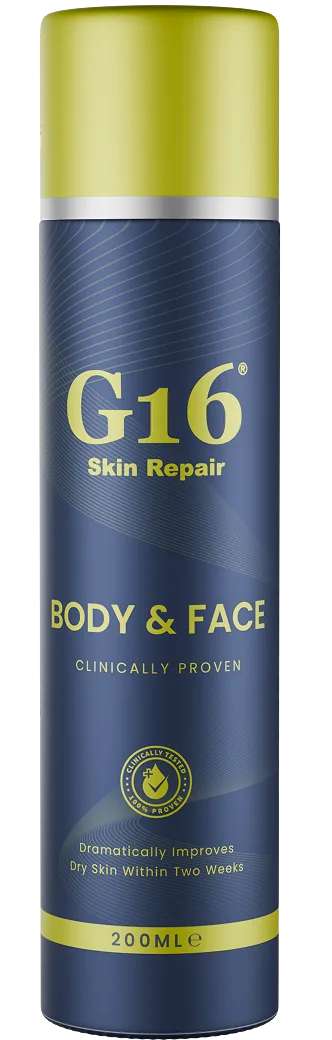
G16 Skin Repair Lotion is a cosmetic moisturiser. Patch test on a small area before first use, keep it away from the eyes and mucous membranes, and keep it out of reach of children. If your skin is broken, bleeding or infected, or if it gets worse rather than better, speak to a GP or a dermatologist.
