



Every year, usually within a fortnight of the heating going on, skin that was perfectly fine all summer starts to tighten, flake and itch. It is not your imagination, and you have not started doing something wrong. Winter dries your skin from two directions at once, and once you can see the mechanism the fix is fairly obvious.
This is why the same skin that behaves perfectly in August starts flaking in November. Nothing about your skin has changed. Its environment has.
The numbers behind it
Warm air holds far more water vapour than cold air. Air at 20°C can hold roughly four times as much as air at 0°C. So when winter air comes indoors and gets heated, its relative humidity collapses.
A heated home in winter commonly sits at 10 to 20 per cent relative humidity. That is drier than most deserts. Skin is generally comfortable somewhere between 40 and 60 per cent.
| What changes in winter | Effect on skin |
|---|---|
| Cold outdoor air | Holds little water, so it draws moisture from exposed skin |
| Indoor heating | Drops indoor humidity to 10-20%, well below comfortable |
| Hotter, longer showers | Strips more of the oils that keep water in |
| Wind | Removes the thin layer of humid air that normally sits against the skin |
| Less sunlight | Lower vitamin D, and for some people conditions like psoriasis worsen |
| Heavier clothing | Wool and synthetics rub, and sweat trapped under layers irritates |
What to change, in order of impact
1. Add humidity indoors
The single highest-value change, because it addresses the actual cause rather than compensating for it. A humidifier in the bedroom alone makes a noticeable difference, since that is where you spend eight uninterrupted hours. If you would rather not buy one, drying laundry indoors and leaving bowls of water near radiators both help, if less precisely.
2. Change how you shower
A hot shower in a cold house is one of life's pleasures and it is doing real damage. Lukewarm, under ten minutes, and a non-soap cleanser rather than a foaming gel.
3. Moisturise on damp skin
Within three minutes of getting out, before the water on your skin evaporates. Applying moisturiser to bone-dry skin traps far less. This one change often outperforms buying a more expensive product.
4. Switch to something heavier for the season
A light summer lotion will not hold up in December. Look for occlusives, meaning ingredients that physically slow water loss: petrolatum, mineral oil, dimethicone, shea butter. Ointments beat creams, creams beat lotions, in that order for barrier protection and in reverse order for how pleasant they feel.
5. Cover up outside
Gloves, and something over the lower face in wind. Exposed skin loses water fastest, and wind strips away the boundary layer of humid air that normally protects it.
6. Keep using sunscreen
UVA passes through cloud and glass year round, and snow reflects a significant amount of UV back up at you. Winter sun damage is real and it contributes to the long-term thinning that makes skin drier.
When it is more than winter dryness
Winter unmasks conditions that are manageable the rest of the year. If your winter skin is not just tight but genuinely scaly, there may be something underneath:
- Ichthyosis vulgaris is dramatically seasonal. Many people are nearly clear in summer and heavily scaled by January. Fine scale on the shins and outer arms, often lifelong and familial.
- Keratosis pilaris reliably worsens in winter. Rough bumps on the backs of the arms and fronts of the thighs.
- Asteatotic eczema, sometimes called winter itch, gives a cracked crazy-paving appearance, usually on the lower legs and most often in older adults. It needs treating as eczema.
- Psoriasis commonly flares in winter with less sunlight.
Where G16 fits, and where it does not
If your winter problem is simple water loss, meaning skin that feels tight and looks dull but has nothing to lift off, then a good emollient and a humidifier are the right answer and G16 is not what you need.
Where it fits is the other version: winter skin that has gone visibly scaly or flaky, where dead skin has built up rather than shedding. Its glycolic and lactic acid loosen that build-up so it comes away, and the aloe vera, glycerin and shea butter hydrate underneath as it does.
It is not for skin that is already cracked open or inflamed, which needs settling first. And it does not replace the humidifier: if the air in your house is at 15 per cent humidity, that is going to keep pulling water out of your skin whatever you put on it.
When to see a doctor
- Skin is cracking deeply enough to bleed.
- There is redness, heat, swelling or weeping, suggesting infection or eczema rather than dryness.
- Itching is bad enough to disturb sleep.
- It is not improving despite several weeks of proper winter care.
- An older relative's lower legs have a cracked crazy-paving look, which is asteatotic eczema and treatable.
Common questions
Somewhere between 40 and 60 per cent suits skin well. Going much above 60 encourages mould and dust mites, so higher is not better. A cheap hygrometer tells you where you actually are, and most heated homes in winter are startlingly low, often 10 to 20 per cent.
Only if you are genuinely dehydrated. If you are drinking normally, more water does not add moisture to the outer layer of skin, because that layer takes its water from the air and from what you apply, not from the bloodstream. Humidity and barrier care do far more than a bigger water bottle.
Because humidity is doing half your skincare for you the rest of the year. If the change is dramatic rather than mild, it can also mean you have a mild underlying condition such as ichthyosis vulgaris or keratosis pilaris that summer humidity keeps invisible and winter exposes.
Yes, on exposed skin. UVA penetrates cloud and window glass all year and is the wavelength most associated with skin ageing, which includes the thinning that makes skin drier over decades. Snow also reflects a substantial share of UV back at your face.
The product behind this guide
G16 Skin Repair is a glycolic and lactic acid body lotion for built-up, scaly and thickened skin.
200ml. Made in the UK. 21 day money back guarantee.
Dry skin treatment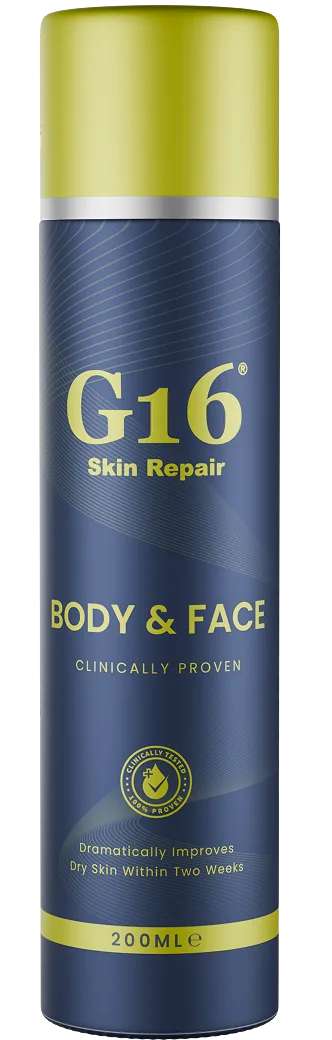
G16 Skin Repair Lotion is a cosmetic moisturiser. Patch test on a small area before first use, keep it away from the eyes and mucous membranes, and keep it out of reach of children. If your skin is broken, bleeding or infected, or if it gets worse rather than better, speak to a GP or a dermatologist.
