



Small rough patches on the skin are most often just dry skin or keratosis pilaris, and both settle with regular moisturising and a gentle exfoliating lotion. Round dry patches that are itchy, or that spread with a ring-shaped edge, are more likely to be discoid eczema or a fungal infection, which need different treatment. A small spot that feels like sandpaper on sun-exposed skin and will not go away is worth showing to a GP, because it may be an actinic keratosis.
Many rough patches are easier to feel than to see. That texture is a useful clue. How it feels, where it sits and how it changes over a few weeks usually points to the cause. If your patches are mainly visible flaking or scale, the guide to scaly patches on skin covers that side in more depth. This page is about the texture you feel with your fingertips.
Start with how it feels
Run a fingertip over the patch with your eyes closed. Tight and papery suggests dryness, many tiny bumps suggest keratosis pilaris, and one small gritty spot is the texture to take most seriously.
| How it looks and feels | Where it usually appears | Likely cause |
|---|---|---|
| Rough, tight, dull, no clear edge | Shins, forearms, hands, elbows | Dry skin |
| Many tiny rough bumps around hair follicles | Upper arms, thighs, buttocks, cheeks | Keratosis pilaris |
| Small sandpapery spot, pink or skin coloured, keeps coming back | Face, bald scalp, ears, backs of hands, forearms | Actinic keratosis (see a GP) |
| Raised, waxy, brown or tan, looks stuck on | Chest, back, face, anywhere in adults | Seborrhoeic keratosis |
| Round, coin-sized, itchy, may weep or crust | Legs, arms, trunk | Discoid (nummular) eczema |
| Pale, faintly rough, poorly defined | Cheeks and arms of children | Pityriasis alba |
| Ring-shaped, raised scaly edge, clearer middle, spreading | Trunk, limbs, groin | Ringworm (fungal) |
| Thick, well-defined, silvery scale | Elbows, knees, scalp, lower back | Possible psoriasis (see a GP) |
The common causes in more detail
Dry skin
This is the commonest reason for rough skin by a long way. When the outer layer loses water it stiffens, the surface cells lift slightly at the edges, and the skin feels rough rather than smooth. It has no sharp border, is worst in winter, and improves within a week or two of moisturising twice a day. For the background, see what causes dry skin.
Keratosis pilaris
Keratosis pilaris happens when keratin, the tough protein in the outer skin, collects in the openings of hair follicles and forms small plugs. Each plug is a tiny rough bump, and together they feel like sandpaper or permanent goosebumps. It is very common, harmless and often runs in families. Gentle chemical exfoliation helps far more than scrubbing.
Actinic keratosis
Actinic keratoses are small rough spots caused by years of sun exposure. They are often easier to feel than to see: a gritty point that catches your finger, sometimes with a little scale that comes off and grows back. They appear on the areas that have had the most sun, and are most common in fair-skinned people over about 40. They are not dangerous in themselves, but a small proportion can develop into a type of skin cancer, so they should be looked at by a GP rather than treated at home with moisturisers or exfoliants.
The sandpaper test. A single small rough spot on sun-exposed skin that you can feel more easily than you can see, and that keeps coming back after the scale is picked or rubbed off, is the one rough patch that should go to a GP rather than into a skincare routine.
Seborrhoeic keratosis
These are very common harmless growths in adults, and most people have several by later life. They are raised, often brown, with a waxy, warty or crumbly surface that looks as if it has been stuck on to the skin. Exfoliants will not remove them. Any growth that changes quickly, bleeds or looks different from your others should be checked.
Discoid (nummular) eczema
Discoid eczema produces round or oval patches, roughly the size of a coin, that are rough, intensely itchy and sometimes weeping or crusted. Because they are inflamed, acids and scrubs usually make them sting and flare. They usually need an emollient plus prescribed treatment from a GP.
Pityriasis alba
Mostly seen in children and teenagers, this causes pale, slightly rough, poorly defined patches, usually on the cheeks and upper arms. It is harmless and slowly fades with gentle moisturising. Acid lotions are not appropriate for young children without medical advice.
Ringworm
Despite the name, ringworm is a fungal infection, not a worm. It forms a ring with a raised, rough, scaly edge and a clearer centre, and it slowly spreads outwards. It needs an antifungal cream from a pharmacy; moisturising or exfoliating it will not help.
Psoriasis
Psoriasis usually produces thicker, well-defined plaques with silvery scale on the elbows, knees, scalp or lower back. If that description fits, see a GP for a diagnosis rather than trying to manage it with general skincare.
Why round dry patches are different
Ordinary dryness rarely makes neat circles. A round, well-defined patch usually points to something more specific: discoid eczema if it is itchy and uniformly rough, ringworm if the edge is more active than the centre and it is growing, or occasionally psoriasis if it is thick with silvery scale.
What helps rough texture you can feel
For dry skin and keratosis pilaris, which account for most rough patches:
- Stop stripping the skin with hot showers and ordinary soap.
- Moisturise while the skin is still damp, twice a day. For many people a plain pharmacy emollient is all they need.
- Add a chemical exfoliant if roughness persists. Lactic acid, glycolic acid, urea or salicylic acid loosen the dead skin that makes the surface feel rough, so it lifts away gradually.
- Skip harsh scrubs, which redden bumps without clearing the plugs.
- Judge after about four weeks, as texture changes slowly.
Where G16 fits, and where it does not
G16 Skin Repair Lotion is a light, non-greasy body lotion with glycolic acid as its second ingredient and lactic acid behind it. These two AHAs loosen built-up dead skin so it lifts away, while aloe vera, glycerin, panthenol, allantoin, vitamin E and shea butter hydrate underneath. That makes it relevant to rough patches caused by dry skin and keratosis pilaris, where the roughness is retained dead skin on intact skin.
Used twice daily and left on as long as possible, there is often a flakier phase around day five to seven, and a visible difference usually shows within the first two weeks. The full course is 28 days. Patch test first, use sunscreen on exposed areas because AHAs increase sun sensitivity, and on the face dilute it with 50ml of a regular aloe moisturiser per 100ml of G16, avoiding the eye area.
It is not for actinic keratoses, seborrhoeic keratoses, ringworm, or any patch that is broken, cracked, inflamed or infected. It is also the most expensive option compared with pharmacy creams, and for mild roughness a cheap emollient or a pharmacy urea cream may be all you need. Acid lotions are not for babies or infants without medical advice.
When to see a GP
- A small rough or sandpapery spot on sun-exposed skin that persists or keeps returning, especially if you are over about 40.
- Any patch that bleeds, crusts repeatedly, ulcerates or does not heal.
- A growth that changes in size, shape or colour, or looks different from your others.
- A ring-shaped patch that is spreading or not improving after two weeks of antifungal cream.
- Round, intensely itchy, weeping or crusted patches.
- Thick, well-defined patches with silvery scale on the elbows, knees or scalp.
- Rough patches in a baby or young child that worry you. Ask a GP or health visitor.
Common questions
Across a wide area, such as the upper arms or thighs, they are usually keratosis pilaris. A single small sandpapery spot on sun-exposed skin such as the face, scalp or backs of the hands may be an actinic keratosis, caused by long-term sun damage, and should be checked by a GP.
Round, well-defined dry patches are often discoid eczema, which is itchy and coin shaped, or ringworm, a fungal infection with a rougher spreading edge and a clearer centre. Ordinary dry skin rarely forms neat circles, so round patches are worth getting looked at if they do not settle.
If it is dry skin or keratosis pilaris, a gentle chemical exfoliant such as lactic acid, glycolic acid or urea can loosen the rough surface over a few weeks. Do not try to exfoliate actinic keratoses, seborrhoeic keratoses, fungal patches or inflamed eczema. Those need the right diagnosis first.
Most are harmless dry skin or keratosis pilaris. The ones to take seriously are persistent rough spots on sun-exposed skin, patches that bleed or do not heal, and any growth that changes quickly. Those are worth a GP appointment.
Simple dryness usually feels better within one to two weeks of moisturising twice daily. Keratosis pilaris and retained build-up take longer, typically four weeks or more of consistent use. If nothing has changed after about four weeks, the cause may be something else and it is worth seeing a pharmacist or GP.
The product behind this guide
G16 Skin Repair is a glycolic and lactic acid body lotion for built-up, scaly and thickened skin.
200ml. Made in the UK. 21 day money back guarantee.
Dry skin treatment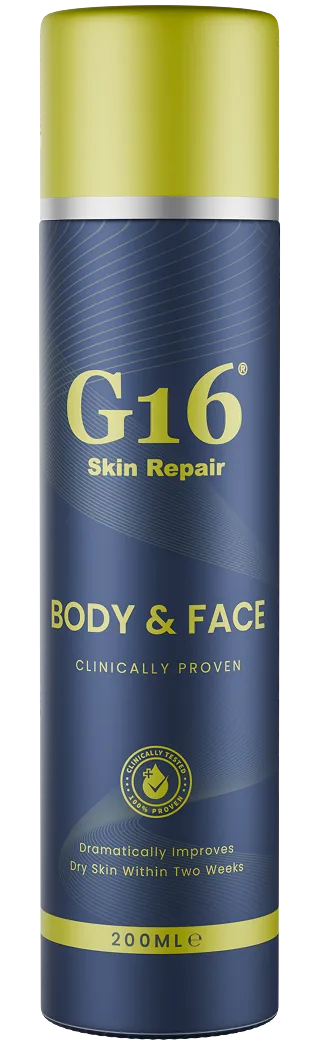
G16 Skin Repair Lotion is a cosmetic moisturiser. Patch test on a small area before first use, keep it away from the eyes and mucous membranes, and keep it out of reach of children. If your skin is broken, bleeding or infected, or if it gets worse rather than better, speak to a GP or a dermatologist.
