


A lamellar ichthyosis diagnosis usually arrives in the first days of a baby’s life, to parents who have never heard the word before and are being handed a great deal of information at once. This page is orientation in plain English. It is not a substitute for the dermatology team, who should lead the care, but it may make the next conversation with them easier.
Lamellar ichthyosis is a rare, more severe form of inherited ichthyosis, affecting roughly one person in 200,000 to 300,000. It sits within a group called autosomal recessive congenital ichthyosis, and about half of cases involve changes in the TGM1 gene, which makes an enzyme needed to build the skin’s outer barrier. Recessive inheritance means both parents carry a copy without being affected themselves, so it is almost always a complete surprise to the family.
How it presents
At birth
Most affected babies are born as a collodion baby, encased in a tight, shiny, translucent membrane that looks like cling film. It sounds alarming and it is managed well in neonatal units. The membrane sheds over the first two to four weeks, revealing the scaling underneath.
Collodion babies need careful hospital management: they lose heat and water rapidly through the membrane, and are at risk of infection and electrolyte disturbance.
Afterwards
- Large, plate-like scales, typically brown or grey, with a defined edge, often described as looking like tiles or armour. This is the feature that gives the condition its name.
- Covering the whole body, including the creases, unlike ichthyosis vulgaris and X-linked ichthyosis which usually spare them.
- Ectropion, where tight skin pulls the lower eyelids outward. This needs ophthalmology input, because it leaves the eye exposed and vulnerable.
- Eclabium, the same tightening turning the lips outward.
- Reduced sweating, because scale blocks the sweat ducts. This is a genuine safety issue in hot weather and during exercise.
- Thickened palms and soles, sometimes with painful fissures.
- Sparse or absent hair in scarred areas of scalp, and nail changes.
Overheating is the risk to take most seriously. If the skin cannot sweat, the body cannot cool itself normally, and children in particular can overheat quickly in hot weather, during sport, or in a warm car. Cooling strategies, spray bottles, cool clothing, air conditioning and shade are not comfort measures here, they are safety measures. Families should have a plan and schools should know about it.
How it is managed
There is no cure. Management is lifelong and it is genuinely demanding, often an hour or more a day. Care should be led by a dermatologist, ideally one with experience of ichthyosis.
Bathing and scale removal
Long soaks, often daily and sometimes twice daily, to soften the scale, followed by gentle mechanical removal with a soft cloth or brush. Some families add bath oils or salt. This is the core of the routine and it is time-consuming.
Emollients and keratolytics
- Emollients in large quantities, applied immediately after bathing. Families typically go through very large volumes, and in the UK these are prescribable.
- Keratolytics to loosen the scale: urea, lactic acid, glycolic acid, propylene glycol preparations. Strengths and combinations should be guided by the dermatology team, particularly in children, where absorption across a large and compromised skin surface is a real consideration.
Systemic treatment
Oral retinoids, usually acitretin, are frequently used in lamellar ichthyosis and can be very effective at reducing scale. They carry significant side effects including bone changes with long-term use and severe risk in pregnancy, so they are prescribed and monitored specialist-only.
The rest of the picture
- Eyes. Regular ophthalmology review for ectropion and corneal exposure. Lubricating drops are often needed, and surgery sometimes.
- Ears. Scale builds in the ear canal and can affect hearing. Periodic review is worthwhile.
- Temperature. As above, planned for actively.
- Infection. A compromised barrier means a higher risk, so new redness, pain, weeping or odour should be looked at promptly.
- Psychological support. A highly visible lifelong skin condition carries a real social burden. This should be offered rather than waited for.
Where G16 fits, and where it does not
Being straightforward about this matters more here than anywhere else on the site.
G16 Skin Repair is a keratolytic lotion using glycolic and lactic acid, so it belongs to the same family as the topical keratolytics used in ichthyosis generally, and some people with lamellar ichthyosis do use acid-based lotions as part of a wider routine.
But lamellar ichthyosis is a severe condition requiring specialist care, and it should not be self-treated with an over-the-counter product on a dermatologist's behalf. Anyone with this diagnosis, or caring for a child with it, should be led by their dermatology team on what to apply, at what strength and how often. Large-surface application on compromised skin, especially a child's, is a clinical decision and not one to take from a website.
It is not a cure, it is not formulated for harlequin ichthyosis, and it should not go on skin that is broken, fissured or infected. It does nothing for ectropion, reduced sweating or any of the non-skin features, all of which need their own care.
If your dermatologist is content for you to trial an AHA lotion as part of the routine, that is a reasonable conversation to have with them. That order round is the right one.
Support
For a rare condition, patient organisations are often more useful than anything else available. The Ichthyosis Support Group in the UK and FIRST, the Foundation for Ichthyosis and Related Skin Types, in the US both provide information written for families, and put people in touch with others who live with the same thing.
Common questions
No. Both are autosomal recessive congenital ichthyoses, but harlequin ichthyosis is caused by changes in a different gene, ABCA12, and is considerably more severe, presenting at birth with thick armour-like plates and deep fissures. Lamellar ichthyosis is serious but much less so, and outcomes are very different.
A baby born encased in a tight, shiny, translucent membrane resembling cling film. It sheds over roughly two to four weeks. It is the usual presentation of lamellar ichthyosis, though not all collodion babies go on to have it, and a minority have essentially normal skin afterwards. These babies need neonatal care because they lose heat and fluid rapidly.
The thick plates of scale physically block the openings of the sweat ducts, so sweat cannot reach the surface to evaporate. Since evaporation is how the body sheds heat, overheating becomes a real risk in hot weather and during exercise. It is one of the most important practical aspects of the condition to plan around.
It is inherited recessively, which means both parents carry a copy. Where both are carriers, each pregnancy carries a one in four chance of an affected child. A clinical genetics service can confirm the pattern for your family, discuss testing and explain the options, and that is a far better source than any general guidance.
The product behind this guide
G16 Skin Repair is a glycolic and lactic acid body lotion for built-up, scaly and thickened skin.
200ml. Made in the UK. 21 day money back guarantee.
Ichthyosis treatment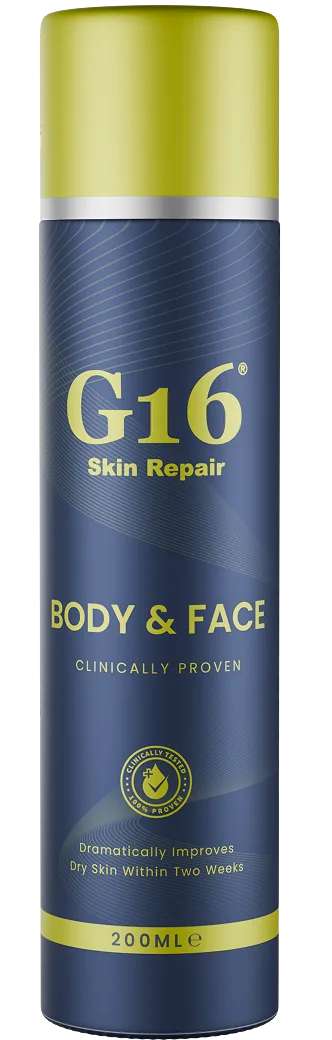
G16 Skin Repair Lotion is a cosmetic moisturiser. Patch test on a small area before first use, keep it away from the eyes and mucous membranes, and keep it out of reach of children. If your skin is broken, bleeding or infected, or if it gets worse rather than better, speak to a GP or a dermatologist.
