


Urea creams come in four broad strength bands: about 5 per cent for gentle everyday hydration, 10 per cent for dry, rough body skin, 20 to 25 per cent for hard skin on the feet, elbows and knees, and 30 to 40 per cent for small areas of very thick skin. Yes, 10 per cent urea is good for most dry skin on the body and hands; it is the strength many people find hits the balance between comfort and visible smoothing. Higher is not automatically better, because stronger urea stings more and is meant for tougher skin.
The number on the tube changes what urea does. At low strengths it is a humectant that pulls water into the skin. As the percentage rises it becomes keratolytic, breaking down keratin and softening thickened skin. Choosing the right strength is mostly a matter of matching that shift to the job in front of you. For the broader background on how urea works, see our guide to urea cream for dry skin; this page focuses on picking the percentage.
What the percentage actually means
The figure is the proportion of urea in the product by weight. A 10 per cent cream contains 10g of urea in every 100g. It tells you how much urea is there, not how the cream will feel, because the base matters too. A 10 per cent ointment feels richer than a 10 per cent lotion, and some ranges add lactic acid, which changes the effect. Compare like with like, and read the full ingredient list rather than just the number.
Urea strengths at a glance
| Strength | What it does | Sting risk | Good for |
|---|---|---|---|
| 2 to 5 per cent | Hydrates, little exfoliation | Low on intact skin | Face, sensitive skin, everyday maintenance |
| 10 per cent | Hydrates and mildly smooths | Low to moderate on very dry skin | Body, arms, shins, hands, rough patches |
| 20 to 25 per cent | Softens hard skin | Moderate, especially on cracks | Heels, soles, elbows, knees |
| 30 to 40 per cent | Strongly keratolytic | Higher, and not for broken skin | Calluses, very thick small areas, short courses |
Is 10 per cent urea good for skin?
For most adults with dry body skin, yes. It is strong enough to make dry shins, arms and the backs of the hands feel noticeably smoother and less tight, and mild enough to use once or twice a day over large areas for as long as you need.
It is less suitable for two groups. On the face, 10 per cent is more likely to sting and is usually more than facial skin needs, so a 5 per cent or a urea face product is a better starting point. On thick heels and calluses, 10 per cent is too weak to make much difference to hard skin, and a 20 to 25 per cent foot cream will do far more.
How to choose your strength
Three questions usually settle it:
- Is there visible thickening, or is the skin just dry? Dry, tight skin with little visible scale needs hydration, so 5 to 10 per cent. Hard, yellowish or ridged skin needs softening, so 20 per cent and above.
- Where is it? Thin skin (face, neck, inner arms) suits the low end. Thick skin (heels, soles, elbows, knees) tolerates and needs the high end.
- Is the skin intact? Cracks, cuts and raw patches sting badly with urea at any strength above the lowest. Let them close first, using a bland emollient, then start low.
Start lower than you think you need. A 10 per cent cream used twice a day, every day, usually does more than a 40 per cent cream used now and then because it stings. If after three or four weeks of steady use the skin is comfortable but still rough, that is the moment to step up, not before.
Signs you should go up a strength
- The skin feels comfortable after applying, but the roughness or hard skin has not changed after several weeks.
- Heels or soles are still thick and ridged despite a 10 per cent cream.
Signs you should come down
- Stinging that lasts longer than a minute or two after applying.
- Redness, burning or a raw feeling, especially on the face or hands.
- The skin has smoothed out and you now only need maintenance.
Strengths by body area
Face
Stay at around 5 per cent, ideally in a product made for the face. Keep it away from the eyes and lips. If facial dryness comes with redness or burning, a plain gentle moisturiser is the better choice.
Hands
Five to 10 per cent suits most dry hands, applied after washing. Split fingertips and cracked knuckles will sting at higher strengths, so keep those to a bland cream until they close.
Feet
Feet are where the high strengths earn their place. Most heel balms sit at 20 to 25 per cent, and 30 to 40 per cent is used for calluses and very thick areas for short periods. Apply after bathing, when the skin is soft. Our cracked heels guide covers the full foot routine. If you have diabetes, neuropathy or poor circulation, ask a podiatrist before using strong keratolytics on your feet.
Children
Children's skin is thinner and more reactive. Low strengths are what pharmacists generally suggest for older children with dry skin, always following the age guidance on the pack. Ask a pharmacist or GP before using 10 per cent or above on a child, and do not use urea or acid creams on babies without medical advice.
Why higher strengths sting
Urea is generally well tolerated on intact skin, but it can sting on skin that is very dry, cracked or freshly shaved, and the effect grows with the strength. A brief tingle that fades is common. Persistent burning is a sign to stop, let the skin settle with a plain emollient, and restart at a lower percentage. Patch test any new product at 20 per cent or above on a small area first.
Where G16 fits, and where it does not
G16 Skin Repair is not a urea cream, so it does not have a strength in this sense. It is an AHA lotion: glycolic acid is the second ingredient after water, with lactic acid behind it, and together they loosen built-up dead skin so it lifts away, while aloe vera, glycerin, panthenol, allantoin, vitamin E and shea butter hydrate underneath. It is a light, non-greasy 200ml lotion, made in the UK.
Its place is built-up scale across larger areas, such as rough, thickened or fish-scale patches on the legs, arms and torso, where a 10 per cent urea cream keeps the skin comfortable but the build-up keeps returning, and a 40 per cent cream is too harsh to spread over a whole limb. Used twice daily and left on as long as possible, ideally around ten hours, there is usually a flakier phase around day five to seven and a visible difference typically within the first two weeks. The full course is 28 days, and long-standing thick areas can take up to about six weeks.
Where it is not the right tool: for ordinary dryness a 5 or 10 per cent urea cream is cheaper and often all you need, and G16 is the most expensive option. For thick heels, a high-strength urea foot cream is a well-established choice. G16 increases sun sensitivity, so use sunscreen on exposed areas. It is not for broken, cracked, raw, inflamed or infected skin, and is not for babies or infants without medical advice. Patch test first.
When to see a GP
- Dry, thickened skin that does not improve after a month of regular use of an appropriate strength.
- Skin that is red, weeping, cracked and bleeding, or showing signs of infection.
- Thick skin on the feet if you have diabetes, neuropathy or poor circulation: see a podiatrist.
- Any dry skin problem in a baby or young child, before using medicated creams.
Common questions
It is a moderate, everyday strength. At 10 per cent urea mainly hydrates, with a mild smoothing effect, which is why it is common in body lotions. It is stronger than facial skin usually needs, and weaker than the 20 to 40 per cent creams used on hard skin on the feet.
Some people tolerate it, but 5 per cent or a urea product made for the face is a safer starting point, because facial skin is thinner and stings more easily. Keep any urea cream away from the eyes and lips, and stop if it causes lasting redness or burning.
Most heel creams use 20 to 25 per cent, which softens hard skin without being too harsh for daily use. For very thick calluses, 30 to 40 per cent can be used on small areas for short periods. Keep strong creams off open cracks, and see a podiatrist first if you have diabetes.
For adults, used as directed on small areas of thick skin such as calluses or hard heels, it is widely used. It is not a general moisturiser, it is too strong for the face or thin skin, and it stings on broken skin. Patch test first and follow the pack instructions.
Low-strength urea creams are sometimes used for older children, following the age guidance on the pack. Children's skin stings more easily, so ask a pharmacist or GP before using 10 per cent or higher on a child, and do not use urea or acid creams on babies without medical advice.
The product behind this guide
G16 Skin Repair is a glycolic and lactic acid body lotion for built-up, scaly and thickened skin.
200ml. Made in the UK. 21 day money back guarantee.
Dry skin treatment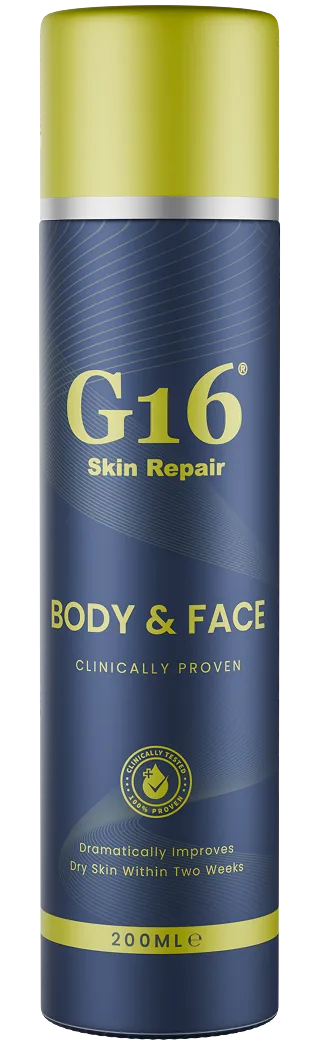
G16 Skin Repair Lotion is a cosmetic moisturiser. Patch test on a small area before first use, keep it away from the eyes and mucous membranes, and keep it out of reach of children. If your skin is broken, bleeding or infected, or if it gets worse rather than better, speak to a GP or a dermatologist.
