


Keratosis pilaris on the face shows up as tiny rough bumps, often with redness, on the outer cheeks, and sometimes the temples, forehead or eyebrows. It is the same harmless, genetic plugging of hair follicles with keratin that causes bumpy upper arms, but facial skin is thinner and more reactive, so it needs a gentler approach: mild acids, steady moisturising and no scrubbing. It cannot be cured, but the roughness and redness can usually be made much less noticeable.
Facial keratosis pilaris is most common in children and teenagers, and often turns up in someone who also has it on the arms or thighs. It is frequently mistaken for acne, rosacea or a rash. Our guide on how to get rid of keratosis pilaris covers the condition on the arms and legs; this page is about the face specifically.
What it looks like on the face
The typical picture is a patch of small, even, pinpoint bumps on the outer part of both cheeks, which feels like fine sandpaper. The bumps are skin-coloured, pink or slightly darker than the surrounding skin, and are usually the same on both sides of the face. There is often a background flush that makes the cheeks look permanently rosy or wind-burnt.
- Cheeks are by far the most common site, especially the outer cheeks in front of the ears.
- Temples and forehead are affected less often.
- Eyebrows can be involved in a related form where the outer third of the brows becomes red and bumpy and the hair there may thin.
The bumps do not come to a head or contain pus, they are not usually itchy, and they do not come and go from day to day the way spots do. Like KP elsewhere, it tends to be worse in winter and better in humid summer weather.
Keratosis pilaris rubra faceiei
Where the redness is the main feature, dermatologists sometimes use the name keratosis pilaris rubra faceiei. The cheeks have a fixed red or pink background, with the tiny rough bumps sitting on top. It often starts in childhood, is more noticeable on paler skin, and can be persistent into adulthood.
The redness in this form is a mix of inflammation around the follicles and visible small blood vessels. Acids and moisturisers can smooth the roughness, but they make far less difference to the redness itself. Where the colour bothers someone, a dermatologist can discuss options such as vascular laser treatment, which skincare cannot replicate.
Smooth first, red second. With facial KP, texture usually responds to gentle skincare within a few weeks. Redness is slower and more stubborn. Judging progress by the feel of the skin rather than the colour stops people giving up too early, or reaching for harsher products that make the redness worse.
Keratosis pilaris on the face in children
Rough, red cheeks in a child are a very common reason for parents to wonder about eczema or an allergy. Facial KP often appears in early childhood, sometimes alongside dry skin, eczema or the fish-scale dryness of ichthyosis vulgaris, which share the same genetic background. It frequently becomes less noticeable through the teenage years and into adulthood.
- Keep it simple: a fragrance-free moisturiser twice a day is the main treatment for most children.
- Avoid scrubs, washcloths and rubbing, which make the cheeks redder.
- Use a gentle cleanser and lukewarm water, and protect the cheeks from cold wind.
- Do not use acid-based products on babies or infants without medical advice. For older children, ask a GP or pharmacist before using anything stronger than a moisturiser.
If you are unsure whether it is KP or eczema, a GP can usually tell by looking. Eczema tends to be itchy, comes and goes in flares, and may weep or crust. KP is a fixed, even texture that is rarely itchy.
Keratosis pilaris versus acne and rosacea
These three are often confused on the cheeks, and treating the wrong one can make things worse. Acne treatments can over-dry KP, and acids that help KP can sting rosacea.
| Feature | Keratosis pilaris | Acne | Rosacea |
|---|---|---|---|
| Typical age | Childhood and teens, can persist | Teens and young adults | Usually starts after 30 |
| Bumps | Tiny, even, rough, no head | Varied sizes, blackheads, whiteheads, pus spots | Red bumps and pus spots, no blackheads |
| Where | Outer cheeks, temples, brows | Forehead, nose, chin, cheeks, back | Central face: nose, inner cheeks, chin |
| Feel | Sandpaper texture | Tender individual spots | Burning or stinging, flushing |
| Changes day to day | Rarely | Yes, spots come and go | Yes, flares with triggers |
| Elsewhere on body | Often upper arms and thighs | Chest and back | Face only, sometimes eyes |
Rosacea in particular needs care. If your face flushes easily with heat, alcohol or spicy food, burns or stings with products, or has visible red vessels across the nose and central cheeks, see a GP before using any exfoliating acids.
How to look after facial keratosis pilaris
The principles are the same as on the arms, but scaled down for thinner skin.
- Cleanse gently. A cream or non-foaming cleanser and lukewarm water. No brushes, scrubs or flannels.
- Moisturise twice daily. A fragrance-free cream with glycerin or ceramides, applied while the skin is still slightly damp.
- Add a mild acid slowly. Lactic acid is often the best starting point on the face, as it is gentler than glycolic acid and also hydrates. Begin two or three evenings a week and build up only if the skin stays comfortable.
- Consider low-strength urea around 5 per cent, which softens keratin while hydrating. The 10 to 20 per cent strengths used for arms are usually too strong for cheeks.
- Wear sunscreen every day. Acids increase sun sensitivity, and sun can deepen redness and marks.
- Leave the bumps alone. Picking or squeezing facial KP leaves red or dark marks that last much longer than the bump.
Give it six to eight weeks before judging. If nothing has changed by then, a GP or dermatologist may suggest a prescription retinoid, which normalises how the follicle sheds but causes dryness at first and is not suitable in pregnancy. For a step by step look at acids and frequency, see how to exfoliate keratosis pilaris.
Where G16 fits, and where it does not
G16 Skin Repair is a light, non-greasy body lotion with glycolic acid as its second ingredient and lactic acid behind it, plus aloe vera, glycerin, panthenol, allantoin, vitamin E and shea butter. It loosens built-up dead skin so it lifts away while hydrating underneath. That combination suits the rough texture of KP, and it is most useful where someone has KP on the arms or legs as well as the face and wants one product for both.
On the face it should be diluted. Anyone using it on the face for the first time, anyone with sensitive skin, and children under 10 are advised to mix 50ml of a regular aloe moisturiser cream per 100ml of G16. Keep it away from the eye area, patch test first, and use daily sunscreen. Acid lotions are not for babies or infants without medical advice.
Where it does not belong: it will not change the fixed redness of keratosis pilaris rubra faceiei, and it is not for rosacea, acne that is inflamed, or any broken, raw or irritated skin. For mild facial KP, a plain pharmacy moisturiser or a gentle lactic acid lotion is often all that is needed, and either costs less, as G16 is the most expensive option compared with pharmacy creams.
When to see a GP
- You are not sure whether it is KP, acne, rosacea or eczema.
- The cheeks burn, sting, flush easily or have visible red vessels.
- Bumps are painful, contain pus, or are spreading.
- Eyebrow hair is thinning along with redness and bumps.
- Redness or texture is causing distress, as prescription and laser options exist.
- A baby or young child has rough, red cheeks and you want it confirmed.
Common questions
It is an inherited tendency for keratin to build up and plug hair follicles. The cheeks are a common site, especially in children and teenagers. Dry weather makes it more noticeable. It is not caused by diet, poor hygiene or anything you did.
No. KP bumps are tiny, even and rough, with no blackheads or pus spots, and they stay much the same from day to day. Acne spots vary in size, come and go, and are often tender. Strong acne products can over-dry and redden KP.
It often becomes less noticeable through the teenage years and into adulthood, though some people keep a degree of it. In the meantime, gentle cleansing and a fragrance-free moisturiser twice a day are the main care. Ask a GP before using acids on a child.
A form of keratosis pilaris on the face where fixed redness of the cheeks is the main feature, with tiny rough bumps on top. Skincare can smooth the texture, but the redness responds less well and may need a dermatologist.
No. The plug sits inside the follicle where a scrub cannot reach, and rubbing makes facial skin redder and more irritated. A mild acid such as lactic acid, a good moisturiser and patience work far better.
The product behind this guide
G16 Skin Repair is a glycolic and lactic acid body lotion for built-up, scaly and thickened skin.
200ml. Made in the UK. 21 day money back guarantee.
Keratosis treatment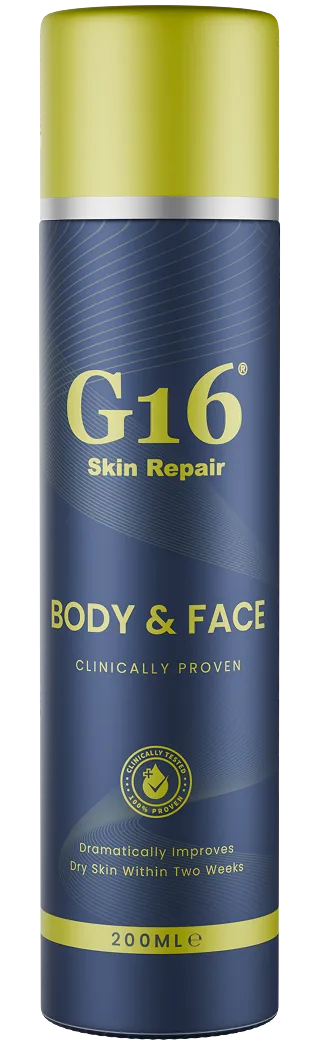
G16 Skin Repair Lotion is a cosmetic moisturiser. Patch test on a small area before first use, keep it away from the eyes and mucous membranes, and keep it out of reach of children. If your skin is broken, bleeding or infected, or if it gets worse rather than better, speak to a GP or a dermatologist.
