



Peeling means the outer layer of skin is coming away in sheets rather than shedding invisibly, and the single most useful question is whether it was preceded by something. Peeling after sunburn, a reaction, a fever or a new product has an obvious cause and resolves on its own. Peeling that arrives without any such trigger, or that keeps happening, is a different conversation.
Skin sheds constantly. You lose roughly a gram of skin cells a day and never notice, because they leave one at a time. Peeling is what happens when the bonds between cells release all at once, or when the layer beneath was damaged and the whole sheet lifts.
Peeling with an obvious trigger
- Sunburn. The commonest cause by a distance. Damaged cells are cleared en masse, usually starting two to five days after the burn. It is the body removing cells it has decided are not worth repairing.
- A new product, particularly retinoids, acids or benzoyl peroxide. Mild peeling in the first weeks of a retinoid is expected. Peeling with burning, swelling or a rash is not, and means stop.
- Over-exfoliation. Increasingly common. Layering acids, scrubs and retinoids strips the barrier faster than it rebuilds, and the skin peels, stings and becomes reactive to things it previously tolerated.
- After a fever or viral illness, including hands and feet peeling days to weeks afterwards.
- Very dry air or wind exposure, especially on the face and lips.
- Contact with irritants, from solvents and detergents to frequent hand washing.
All of these resolve. The correct response is almost always to do less: stop the trigger, use something bland, and leave it alone while it repairs.
Peeling without an obvious trigger
This is where it is worth thinking more carefully.
- Fungal infection, classically between the toes or on the feet, where peeling comes with itch and sometimes a scaly border.
- Eczema, where peeling follows a phase of redness and itching rather than appearing on its own.
- Psoriasis, where the scale is thick and silvery and sits on well-defined raised plaques.
- An inherited shedding condition such as ichthyosis, where the skin has always been like this to some degree and the peeling is continuous rather than episodic.
- Peeling skin on the hands specifically, which has its own long list including contact dermatitis, pompholyx and simple friction.
- Drug reactions, which are uncommon but can be serious, particularly if peeling is widespread and comes with fever or affects the mouth, eyes or genitals.
The one pattern to act on quickly. Widespread peeling with fever, or peeling that involves the lips, mouth, eyes or genitals, or skin that comes away in large sheets leaving raw areas, needs urgent medical attention rather than a product. This is rare, but it is the situation where waiting is the wrong choice.
What to do about ordinary peeling
- Do not pull it off. Peeling skin is still partly attached and still doing a job. Pulling tears living tissue underneath and delays repair.
- Stop the cause. If it followed a product, stop the product. If it followed a burn, protect the area properly.
- Simplify everything. Bland cleanser, bland moisturiser, nothing active, for at least two weeks.
- Moisturise while damp, frequently. Barrier repair is the whole job here.
- Do not exfoliate. This is the instinct and it is the wrong one. Skin that is peeling is already shedding too fast, and helping it along damages the barrier further.
Hands and feet are a special case
Peeling confined to the hands or the feet behaves differently from peeling elsewhere, and it has its own short list of causes.
- Hands: frequent washing and sanitiser are far and away the commonest cause, particularly in healthcare, hospitality and childcare. Contact dermatitis from gloves, detergents or foods is next. Pompholyx produces small deep itchy blisters that peel as they dry.
- Feet: fungal infection is the leading cause, typically between the toes with itch, and it needs an antifungal rather than a moisturiser. Peeling on the soles alone, without itch, is more often friction or dryness.
- Both, after an illness: peeling of the palms and soles can follow a fever by one to three weeks and settles on its own.
The practical point is that hand peeling usually needs protection and less washing, while foot peeling usually needs the right antifungal. Treating either with an exfoliant makes both worse.
Where G16 fits, and where it does not
This is a page where the honest answer is mostly no. G16 is not for peeling skin. It is a keratolytic, meaning it loosens dead cells so they come away, and skin that is already shedding in sheets does not need help shedding. Using it on a sunburn, on over-exfoliated skin or on an active reaction will sting and will make things worse.
There is one situation where it becomes relevant, and it is nearly the opposite problem. Some people describe their skin as peeling when what they actually have is thick, adherent scale lifting at the edges: skin that is accumulating rather than shedding too fast, where flakes catch and lift but the layer underneath stays thickened. That is retention, and it is what G16 is built for, with glycolic and lactic acid loosening the build-up while aloe vera, glycerin, panthenol, vitamin E and shea butter hydrate underneath.
If that is the picture, expect the process to start in the first week, a flakier phase around day five to seven as loosened scale comes away, and a visible difference usually within the first two weeks, with a full course of 28 days and up to about six weeks for heavier build-up.
If your skin is peeling after a burn, a reaction or too many actives, the right answer is a bland moisturiser and time.
When to see a doctor
- Widespread peeling with fever, or peeling involving the lips, mouth, eyes or genitals. Seek help urgently.
- Skin coming away in large sheets leaving raw, weeping areas.
- Peeling that started after beginning a new prescribed medication.
- Signs of infection: spreading redness, warmth, swelling, pus, or a patch that becomes rapidly more painful.
- Peeling between the toes or on the feet with itch, which is usually fungal and needs the right treatment.
- Peeling that keeps recurring in the same place without explanation.
- Peeling in a baby or young child that you cannot account for.
Common questions
No. It looks ready to come away but it is usually still attached at the base, and pulling it tears living skin underneath, which slows healing and can leave marks or let infection in. Keep it moisturised and let it release on its own. If a piece is genuinely loose and catching on clothing, trimming it with clean scissors is safer than pulling.
Almost never. Peeling means the skin is already shedding faster than normal, usually because the barrier is damaged. Exfoliating adds damage to damage, and over-exfoliation is itself one of the commonest causes of peeling in the first place. The instinct is understandable and it is the wrong one. Bland moisturiser and two weeks of leaving it alone does more.
It usually begins two to five days after the burn and runs its course over roughly a week, sometimes longer after a severe burn. Keeping the area moisturised and out of further sun helps it settle. Blistering, fever, chills or feeling generally unwell after sun exposure suggests a more severe burn and should be seen.
The commonest hidden cause is over-exfoliation from stacking acids, scrubs and retinoids, which damages the barrier and produces peeling in skin that is not dry in the ordinary sense. Beyond that, consider fungal infection if it is on the feet or in a spreading ring, a reaction to a product or medication, or an underlying skin condition. Recurrent unexplained peeling in the same place is worth having looked at.
The product behind this guide
G16 Skin Repair is a glycolic and lactic acid body lotion for built-up, scaly and thickened skin.
200ml. Made in the UK. 21 day money back guarantee.
Dry skin treatment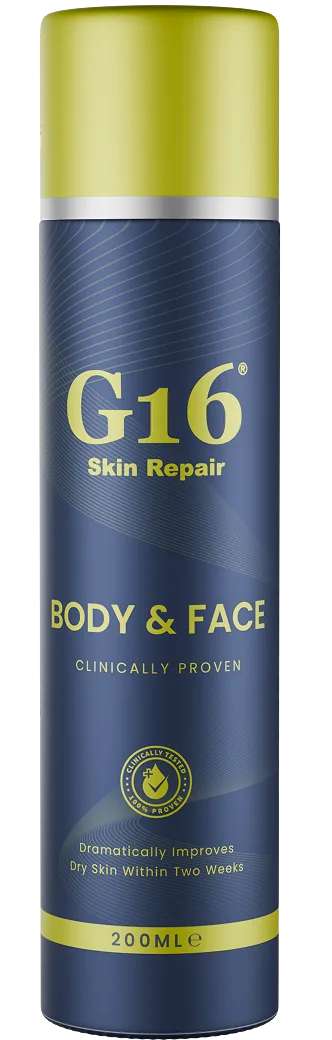
G16 Skin Repair Lotion is a cosmetic moisturiser. Patch test on a small area before first use, keep it away from the eyes and mucous membranes, and keep it out of reach of children. If your skin is broken, bleeding or infected, or if it gets worse rather than better, speak to a GP or a dermatologist.
