



Small red or skin-coloured bumps on the upper arms, rough to the touch and usually not itchy, are almost always keratosis pilaris. It affects a large share of the population, is completely harmless, is not an infection, and is not caused by poor hygiene. The bumps are hair follicles plugged with keratin, the protein the outer skin layer is made of. The redness is the follicle reacting to the plug, not a rash.
That said, several other things produce bumps on the arms, and a few of them need different handling. This page covers how to tell them apart.
How keratosis pilaris presents
- Where: outer upper arms most commonly, then thighs, buttocks and sometimes cheeks. Almost always both sides equally.
- Feel: like fine sandpaper or gooseflesh that does not go away.
- Look: small bumps at hair follicles, skin-coloured, red or brown depending on skin tone. Sometimes with a trapped coiled hair.
- Symptoms: usually none. Occasionally mild itch or dryness.
- Pattern: worse in winter and in dry air, often better in summer. Frequently starts in childhood, peaks in adolescence, and improves gradually with age.
- Family history: very common. It is an inherited tendency.
What else produces bumps on the arms
| Condition | How it differs |
|---|---|
| Folliculitis | Individual bumps can be pustular, tender or itchy, often asymmetric, may follow shaving, hot tubs or occlusive clothing. Infection rather than plugging. |
| Heat rash | Appears suddenly with heat and sweating, often itchy or prickly, resolves as you cool down. |
| Contact reaction | Itchy, in the distribution of whatever touched the skin, appears after an exposure. |
| Acne on the body | Larger, deeper, sometimes tender lesions with visible whiteheads, on shoulders, chest and back more than outer arms. |
| Hives | Raised weals that come and go within hours and move around. Nothing like the fixed roughness of KP. |
| Insect bites | Few in number, very itchy, asymmetric, often in clusters or lines. |
The quickest discriminator. Keratosis pilaris is symmetrical, persistent, rough all over the area, and largely not itchy. Anything that arrived suddenly, itches significantly, is on one side only, contains pus, or is tender to touch is probably something else.
What actually helps keratosis pilaris
Two things need addressing at once: the plug and the dryness that makes it worse.
- Keratolytics. Lactic acid, glycolic acid, salicylic acid or urea loosen the keratin so the plugs release. This is the part that addresses the actual mechanism, and it is the difference between managing it and just moisturising around it.
- Moisturise consistently. Dry skin makes it markedly more visible. Twice daily, on damp skin.
- Stop scrubbing. Physical scrubbing irritates the follicles and often makes the redness worse while doing little to the plugs.
- Warm rather than hot showers, non-soap cleanser.
- Do not pick or squeeze. The bumps are not spots. Picking causes marks that outlast the bump by months.
- Be patient and keep going. It improves with consistent use and returns if you stop, because the underlying tendency does not go away.
The honest bit about redness
Treatment reliably improves the roughness. The redness improves more slowly and less completely, because it reflects follicular inflammation and, in some people, permanently dilated small vessels. Anyone promising to remove the redness entirely is overselling. Smoother, less noticeable and less rough is a realistic goal; perfectly even skin often is not.
What makes it look worse
Several everyday things reliably aggravate keratosis pilaris, and most of them are easy to change.
- Hot showers, which strip the oils that were keeping the surrounding skin smooth.
- Harsh soap, for the same reason.
- Dry indoor air in winter, which is why it is so seasonal.
- Scrubbing and loofahs, which inflame the follicle without shifting the plug, so the bumps get redder rather than smoother.
- Picking, which converts a harmless bump into a mark that lasts months.
- Stopping treatment as soon as it improves, which is the commonest reason people conclude nothing works. It is a maintained condition, not a cured one.
Why it is often mistaken for acne
Both produce bumps, so the confusion is understandable, but treating one as the other wastes months. Acne lesions vary in size, can be tender, come to a head, and appear on the chest, back and shoulders. Keratosis pilaris is uniform, rough to the touch across the whole area, symmetrical on both arms, not tender, and does not come to a head. Acne treatments aimed at bacteria and oil do very little for a keratin plug.
Where G16 fits, and where it does not
Keratosis pilaris is a keratin plugging problem, and G16 is built around glycolic and lactic acid, which loosen exactly that kind of build-up. Aloe vera, glycerin, panthenol, vitamin E and shea butter hydrate the skin at the same time, which matters because dryness makes KP more visible.
Applied twice daily to the affected areas, the process starts in the first week, there is often a flakier phase around day five to seven as loosened keratin comes away, and a visible difference in roughness usually appears within the first two weeks. The full course is 28 days, and more stubborn areas can take up to about six weeks. Because KP is a persistent tendency rather than a one-off, it needs ongoing maintenance rather than a single course.
Where it is not the answer: folliculitis, which is an infection and may need an antibacterial or antifungal approach. Body acne, which needs acne treatment. Anything itchy, weeping, pustular or spreading. Broken or inflamed skin. And it will not remove redness that comes from dilated vessels rather than build-up.
When to see a doctor
- Bumps that are painful, contain pus, or are spreading, which suggests infection rather than KP.
- Sudden onset in adulthood, particularly if widespread or itchy.
- Bumps on one arm only, or in an odd distribution.
- Significant itch, which is not typical of keratosis pilaris.
- Redness and swelling extending beyond the bumps, or a fever alongside.
- Bumps that bleed, ulcerate or fail to heal.
- Distress about appearance, because prescription options exist and are worth discussing rather than suffering quietly.
Common questions
Keratosis pilaris, which is much the most likely cause, is not contagious and is not related to hygiene. It is an inherited tendency for keratin to plug hair follicles. Folliculitis can be infectious in some forms, so bumps that are pustular, tender or spreading are worth distinguishing from KP rather than assuming.
Better not to. They are keratin plugs in follicles rather than spots with contents to release, so squeezing achieves little and inflames the follicle. That inflammation leaves marks which can persist for months, long outlasting the bump itself. Loosening the keratin chemically and moisturising consistently gets you further.
It is managed rather than cured. Many people find it fades substantially with age, often becoming much less noticeable after the thirties. With consistent care the roughness improves a great deal, but the underlying tendency remains, so it usually returns if treatment stops. Thinking of it as maintenance rather than a fix leads to less frustration.
Cold air holds less moisture and indoor heating dries it further, so the skin gets drier, and dry skin makes the plugs more prominent and the surrounding surface rougher. Many people also shower hotter in winter, which strips more oil. The condition itself has not worsened; the conditions around it have. It commonly improves in summer for the same reasons in reverse.
The product behind this guide
G16 Skin Repair is a glycolic and lactic acid body lotion for built-up, scaly and thickened skin.
200ml. Made in the UK. 21 day money back guarantee.
Keratosis treatment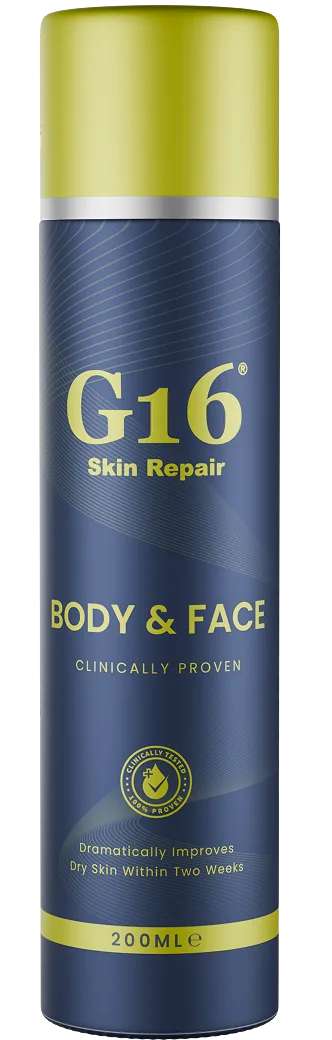
G16 Skin Repair Lotion is a cosmetic moisturiser. Patch test on a small area before first use, keep it away from the eyes and mucous membranes, and keep it out of reach of children. If your skin is broken, bleeding or infected, or if it gets worse rather than better, speak to a GP or a dermatologist.
