



Rough skin texture is nearly always a surface problem, and that is good news, because the surface is the part that turns over fastest. The outer layer of skin replaces itself roughly every four weeks. When shedding slows or cells stick together, the surface stops being smooth and starts catching the light unevenly, which is what "poor texture" actually describes.
Texture is a different problem from tone, and the two get muddled constantly. Tone is about colour and evenness of pigment. Texture is about the physical surface: whether it is smooth or rough, flat or bumpy. This page is about texture.
What causes rough texture
Build-up of dead cells
The most common cause by a wide margin. Cells that should have shed remain attached, layer on each other, and produce a surface that feels like fine sandpaper and looks dull because it scatters light rather than reflecting it. It becomes more pronounced with age as turnover naturally slows.
Dehydration
Skin low in water is less plump, so fine lines and surface irregularity show more. This is reversible quickly and is why skin looks better after a few days of proper moisturising.
Keratosis pilaris
Small rough bumps around hair follicles, typically on the upper arms, thighs and sometimes cheeks. Extremely common, entirely harmless, and caused by keratin plugging the follicle openings.
Congestion and enlarged pores
Blocked follicles create raised irregularity, particularly across the nose and cheeks.
Scarring
Indented or raised scars, most often post-acne. This is a structural change in the dermis rather than a surface one, and it does not respond to surface treatment in the same way.
Sun damage
Cumulative UV exposure degrades collagen and thickens the outer layer unevenly, which coarsens texture over years.
The distinction that decides what will work. Surface texture, meaning build-up, dehydration and follicular plugging, responds well and relatively quickly to the right care. Structural texture, meaning scarring and collagen loss, does not respond to topical products in any meaningful way and needs clinical treatment such as microneedling, resurfacing lasers or peels performed professionally. Being clear which you have saves money and disappointment.
What actually improves surface texture
- Chemical exfoliation. Alpha hydroxy acids such as glycolic and lactic acid loosen the bonds holding dead cells together so they release. Beta hydroxy acid, salicylic acid, is oil-soluble and works inside the follicle, which makes it better for congestion. Urea at higher concentrations does a similar job and hydrates at the same time. This is the single most effective category for genuine build-up.
- Hydration. Humectants such as glycerin draw water into the layer; occlusives such as shea butter slow its loss. Plumped skin reads as smoother immediately.
- Retinoids. Increase cell turnover and, over months, improve both surface and some structural texture. The best-evidenced ingredient in this category, and also the most irritating, so introduce slowly.
- Sun protection. Unglamorous and the highest-return long-term action, because it prevents the coarsening rather than chasing it.
- Time and consistency. The layer turns over in about four weeks, so four weeks is the minimum honest window for judging anything.
What does not work as well as people hope
- Physical scrubs with harsh particles. They remove some surface debris but can create micro-damage, and damaged skin often responds by thickening.
- Stacking multiple actives at once. Acids plus retinoid plus scrub is the fastest route to a damaged barrier, and a damaged barrier looks worse, not better.
- Expecting topical products to fix scarring. They will not, and no amount of consistency changes that.
- Doing it once. Texture is maintained, not cured.
Where G16 fits, and where it does not
G16 Skin Repair is a body lotion built around glycolic and lactic acid, which places it squarely in the first category above. It loosens accumulated dead skin so it comes away, while aloe vera, glycerin, panthenol, vitamin E and shea butter hydrate the layer underneath. For rough, dry, built-up texture on the body, particularly arms, legs, elbows and knees, that is a direct match.
Applied twice daily, the process starts in the first week, there is often a flakier phase around day five to seven as loosened cells lift away, and a visible difference usually appears within the first two weeks. The full course is 28 days, which lines up with how long the outer layer takes to turn over. Heavier or long-standing build-up can take up to about six weeks.
Where it is not the answer: texture caused by scarring, which needs clinical treatment. Congestion and blackheads, where salicylic acid is better suited because it works inside the follicle. Active acne, inflamed skin, or skin that is already over-exfoliated and peeling. And it is formulated for the body, so the face is a different proposition requiring a different strength and more caution.
A realistic order to do things in
Most texture routines fail because everything is started at once, the skin reacts, and the whole thing is abandoned. A slower sequence works better.
- Weeks 1 to 2: fix hydration and washing only. Cooler showers, non-soap cleanser, moisturise on damp skin twice daily. Judge nothing yet.
- Weeks 3 to 4: introduce one exfoliating active, at a low frequency, and increase only if the skin stays comfortable.
- Week 5 onwards: assess honestly against how it looked at the start, ideally with a photograph rather than memory, which is unreliable.
- Only then consider adding anything else. If you add two things at once and the skin reacts, you will not know which caused it.
When to see a doctor or a dermatologist
- Texture change that is new, one-sided, or confined to a single patch that persists or grows.
- A rough scaly area in a sun-exposed site in an adult over about forty that does not resolve.
- Painful, inflamed lesions rather than simple roughness, which suggests acne or folliculitis needing proper treatment.
- Scarring you want addressed, which needs a clinician rather than a product.
- Roughness with redness, itch or flaking that worsens with everything you try, which suggests a barrier problem or an underlying condition.
- No improvement after a full turnover cycle of consistent, sensible care.
Common questions
Hydration improves how skin looks within days. Genuine change in build-up follows the skin's own turnover cycle, which is roughly four weeks, so that is the minimum sensible window for judging results. On the body, a visible difference usually appears within the first two weeks with a full course of 28 days, and thicker long-standing roughness can take up to about six weeks. Scarring does not improve on this timescale at all.
Texture is the physical surface, whether it is smooth or rough, flat or bumpy. Tone is colour and its evenness. They are related, because a rough surface scatters light and reads as duller and patchier, so improving texture often makes tone look better too. But they have different causes and different solutions, and products that address one may do nothing for the other.
Not inherently, but they are easy to overdo and harsh particles can cause micro-damage. Damaged skin frequently responds by thickening, which is the opposite of the goal. Chemical exfoliation tends to be more even and more controllable because it loosens the bonds between cells rather than abrading the surface. If you like the ritual of a scrub, use a gentle one infrequently rather than a gritty one often.
If it is small rough bumps around hair follicles, that is keratosis pilaris, which is very common and harmless. It is managed rather than cured: it improves substantially with consistent keratolytic use and hydration, and tends to return if you stop, because the underlying tendency remains. If it is flat roughness rather than bumps, it is more likely simple build-up, which responds well to the same approach.
The product behind this guide
G16 Skin Repair is a glycolic and lactic acid body lotion for built-up, scaly and thickened skin.
200ml. Made in the UK. 21 day money back guarantee.
Skin blemishes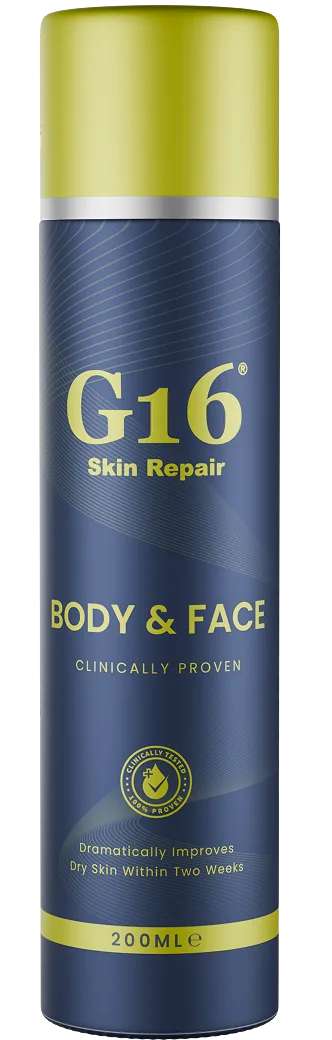
G16 Skin Repair Lotion is a cosmetic moisturiser. Patch test on a small area before first use, keep it away from the eyes and mucous membranes, and keep it out of reach of children. If your skin is broken, bleeding or infected, or if it gets worse rather than better, speak to a GP or a dermatologist.
