



Flaking is dead skin leaving in visible pieces instead of invisibly, and there are only two reasons that happens: the skin has dried out and lost its grip, or it is shedding cells faster than they can be cleared. Almost every cause of flaky skin sits under one of those two headings, and working out which one you have is more useful than any product recommendation, because they need opposite approaches.
The two mechanisms
Dryness. The outer layer holds too little water. Below about ten per cent water content it stops being flexible, so it cracks at the edges and lifts. This is the ordinary version, it is very common, and it responds well to putting water back and stopping whatever is removing it.
Accelerated or disordered turnover. The skin produces cells faster than normal, or fails to release old ones cleanly, so they come away in clumps. Psoriasis is the fast-turnover version. Ichthyosis is the poor-release version. Seborrhoeic dermatitis sits somewhere in between, driven by a yeast that lives on everyone's skin.
How to tell without a diagnosis. Moisturise properly, twice daily, on damp skin, for two to three weeks. Dryness-driven flaking improves substantially. Turnover-driven flaking feels more comfortable but keeps producing flakes at much the same rate. That difference is the single most informative thing you can observe.
Where on the body, and what it suggests
- Shins and forearms. Usually ordinary dryness, especially in winter. Very common and rarely anything more.
- Scalp, eyebrows, sides of the nose, chest. Greasy yellowish flaking here suggests seborrhoeic dermatitis rather than dryness. It needs an antifungal approach, and moisturising alone does very little.
- Elbows, knees, lower back, with thick silvery scale on raised plaques. Suggests psoriasis.
- Face, fine and tight, after starting a new product. Usually irritation or over-exfoliation.
- Between the toes or on the feet, with itch. Often fungal.
- Widespread, since childhood, worse in winter, with fine lines on the palms. Suggests ichthyosis vulgaris.
- Hands, in someone who washes them frequently. Irritant contact dermatitis, extremely common in healthcare, hospitality and childcare.
Causes people usually miss
- Over-exfoliation. Increasingly the commonest cause of facial flaking. Acids, retinoids and scrubs together strip the barrier faster than it rebuilds, and the skin flakes because it is damaged, not because it is dry. The treatment is to stop, not to add.
- Hot water. Long hot showers strip surface lipids very effectively. Many people's flaking improves substantially from this change alone.
- Soap. True soap is alkaline and disrupts the skin's acid mantle. Non-soap cleansers are gentler.
- Central heating, which drops indoor humidity dramatically in winter.
- Hypothyroidism, which produces dry coarse flaking skin alongside fatigue and cold intolerance.
- Medication, particularly retinoids, diuretics and statins.
- Age. Oil production and natural moisturising factors both decline, so flaking becomes more common with each decade.
What to do
- Change the washing before the products. Cooler, shorter showers, non-soap cleanser, pat dry rather than rub. This is free and frequently sufficient.
- Moisturise on damp skin, within about three minutes of drying, twice a day. The same product on bone-dry skin does considerably less.
- Stop exfoliating for two weeks if you have been doing it regularly. If the flaking improves, you have your answer.
- Match treatment to mechanism. Seborrhoeic flaking needs an antifungal. Fungal foot flaking needs an antifungal. Inflamed flaking needs anti-inflammatory treatment. None of those are fixed by moisturiser or exfoliation, and exfoliating inflamed skin makes it worse.
- Add a keratolytic only where build-up is the problem, meaning flaking that persists despite weeks of proper hydration.
The two-week reset
When flaking has been going on for a while and several products have been tried, the most useful thing is usually to strip the routine back rather than add to it.
- Stop every active. No acids, no retinoids, no scrubs, no exfoliating cloths, for two full weeks.
- Cleanse once a day with something bland and non-foaming, and rinse with warm rather than hot water.
- Moisturise on damp skin, twice daily, with something simple.
- Change nothing else, so that whatever happens is attributable.
If the flaking substantially improves, it was barrier damage, and the routine was the cause rather than the cure. If it is unchanged, the flaking is being driven by something the routine was never going to fix, which is genuinely useful to know before spending more money.
Where G16 fits, and where it does not
G16 addresses one of the two mechanisms. Its glycolic and lactic acid loosen accumulated dead skin so it comes away, while aloe vera, glycerin, panthenol, vitamin E and shea butter hydrate the layer underneath. That makes it suited to flaking driven by retained build-up, particularly on the body: rough, scaly, persistent flaking that has not shifted after weeks of consistent moisturising.
Applied twice daily, the process starts in the first week. Expect a flakier phase around day five to seven as loosened cells lift away, which surprises people but is the mechanism working. A visible difference usually appears within the first two weeks, the full course is 28 days, and heavier build-up can take up to about six weeks.
Where it is the wrong choice, and this covers a lot of flaky skin: ordinary winter dryness with no real scale, where a plain emollient is better and cheaper. Over-exfoliated or irritated skin, which needs less, not more. Seborrhoeic dermatitis and fungal flaking, which need antifungal treatment. Anything red, weeping, itchy or inflamed. Broken or infected skin. And it is a body product, so the face is a different proposition.
When to see a doctor
- Flaking with redness, weeping, crusting or significant itch, which suggests inflammation rather than dryness.
- Thick silvery scale on well-defined raised plaques.
- Greasy yellowish flaking on the scalp and face that does not respond to moisturising.
- Flaking between the toes with itch, which is usually fungal.
- Sudden widespread flaking in adulthood, especially with fatigue, weight change, thirst or cold intolerance.
- Any single patch that persists, grows, bleeds or fails to heal, particularly in sun-exposed skin.
- Flaking severe enough to disturb sleep or affect daily life.
- No improvement after several weeks of consistent, sensible care.
Common questions
Three common reasons. The moisturiser may be going on dry skin rather than damp, which traps far less water. The flaking may not be dryness at all, but a turnover problem such as seborrhoeic dermatitis or ichthyosis, where hydration helps comfort but not the flaking. Or something else is stripping the skin faster than you are replacing it, most often hot showers and soap.
It depends which mechanism you are dealing with, and getting it wrong makes things worse. Flaking from retained build-up responds well to gentle chemical loosening. Flaking from a damaged barrier, over-exfoliation or inflammation gets worse with more exfoliation, and this is now one of the commonest causes of facial flaking. If in doubt, stop everything active for two weeks and see what happens.
Not usually. Dandruff is generally seborrhoeic dermatitis, driven by a yeast called Malassezia that lives on everyone's skin, and its flakes tend to be greasier and yellower and sit on slightly red skin. It responds to antifungal shampoos rather than to moisturising. Genuinely dry scalp flaking is finer and drier and accompanies dry skin elsewhere. Treating one as the other is why people get nowhere for months.
Cold air holds far less water than warm air, so skin loses moisture to it faster. Indoor heating then drops humidity further, often below twenty per cent, which is drier than many deserts. On top of that most people take hotter, longer showers in winter, which strips surface oils. Three separate pressures arrive at once, which is why the change can feel so abrupt.
The product behind this guide
G16 Skin Repair is a glycolic and lactic acid body lotion for built-up, scaly and thickened skin.
200ml. Made in the UK. 21 day money back guarantee.
Dry skin treatment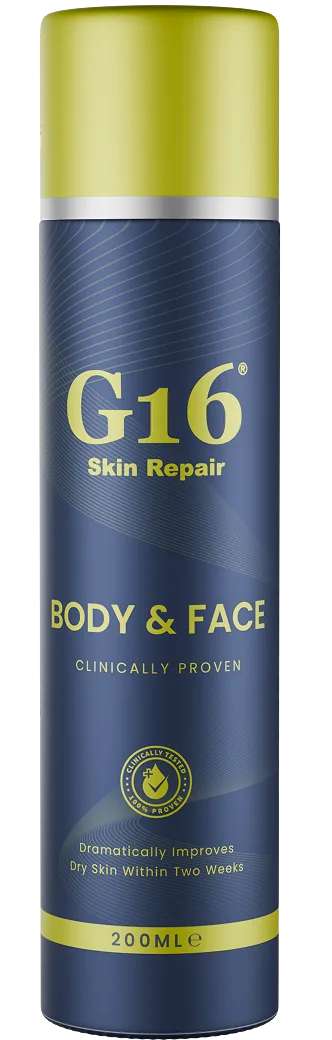
G16 Skin Repair Lotion is a cosmetic moisturiser. Patch test on a small area before first use, keep it away from the eyes and mucous membranes, and keep it out of reach of children. If your skin is broken, bleeding or infected, or if it gets worse rather than better, speak to a GP or a dermatologist.
