


Dry, scaly skin on the legs is so common that it is almost the default state of adult shins in winter, and the reason is anatomical rather than anything you have done wrong. The lower leg has fewer oil glands than almost anywhere else, thin skin over bone with little fat beneath, and it takes the full run of hot water in every shower. Add cold air, central heating and age and the surface dries, stiffens and starts to scale.
Most cases resolve with changes to washing and consistent moisturising. A minority do not, and that failure to respond is itself the most useful diagnostic clue you have.
Why legs and not arms
- Sebaceous gland density is low on the shins and high on the face, chest and back. Less natural oil means less to hold water in.
- Hot water runs down the legs last and lingers longest, stripping surface lipids on the way past.
- Thin skin over bone, with little subcutaneous fat to buffer it.
- Shaving, which removes surface cells along with hair and is a major contributor on the lower legs.
- Trousers and tights creating constant low-grade friction.
- Circulation. The lower legs are the furthest point from the heart and the first place reduced circulation shows.
What is actually happening in the skin
Two different problems produce a similar appearance, and separating them is the point of this page.
Water loss. The outer layer holds too little water, so it becomes inflexible and starts to flake. This is ordinary dryness. It responds well and quickly to putting water back and stopping whatever is stripping it.
Retention of dead cells. The skin makes new cells normally but sheds the old ones too slowly, so they pile up into visible scale. Hydration softens that pile without removing it, which is why the scale reappears within hours of moisturising. This is the pattern in ichthyosis vulgaris and in long-standing thickened skin.
The test that tells you which one you have. Moisturise the legs properly, twice daily, for two to three weeks. Ordinary dryness improves substantially. If the legs feel better but still look scaly, and the scale returns within a day of each application, you are dealing with retention rather than dryness, and hydration alone will never quite finish the job.
Causes worth ruling out
- Ichthyosis vulgaris, the commonest inherited shedding disorder. Present since childhood, worse in winter, classically on the shins with fine scale, often with very fine lines on the palms.
- Hypothyroidism, which produces dry coarse skin alongside fatigue, cold intolerance and weight gain.
- Diabetes, which affects both hydration and sweating in the lower limbs.
- Kidney disease, where dryness and itch are very common.
- Venous insufficiency, where poor return of blood from the legs causes dryness with swelling, aching and colour change around the ankles. This one needs proper assessment rather than moisturiser.
- Medication, particularly diuretics, statins and retinoids.
- Keratosis pilaris, if the texture is small rough bumps around hair follicles rather than flat scale.
What helps, in order of how much difference it makes
- Change the shower before you change the lotion. Cooler water, shorter time, non-soap cleanser, pat dry. Most people underestimate how much of the problem this is.
- Moisturise within three minutes of drying, while the skin is still damp. The same product applied to bone-dry skin does considerably less.
- Twice daily, not once. Consistency matters more than which product, up to a point.
- Rethink shaving. Shave at the end of the shower, with the grain, on well-hydrated skin, and moisturise afterwards. Blunt blades cause far more irritation than sharp ones.
- Add a keratolytic if scale persists, meaning something like glycolic, lactic or salicylic acid or urea at higher strength, which loosens the bonds holding dead cells together so the build-up comes away.
Where G16 fits, and where it does not
For legs that are simply dry, with no real scale, an ordinary emollient is the right answer and will cost you less. G16 is not designed to compete with that and there is no point using it for that job.
Where it earns its place is legs with persistent visible scale that has not responded to weeks of proper moisturising. The glycolic and lactic acid loosen the accumulated dead layer so it lifts away, while aloe vera, glycerin, panthenol, vitamin E and shea butter hydrate underneath as that happens.
Applied twice daily, the process starts in the first week. There is commonly a flakier phase around day five to seven as loosened scale comes away, which is the treatment working rather than failing. A visible difference usually appears within the first two weeks, the full course is 28 days, and heavier or longer-standing scaling can take up to about six weeks. Shins are among the slower areas.
Where it does not belong: on skin that is broken, bleeding, inflamed or infected. On legs where the problem is swelling and circulation rather than scale. On freshly shaved skin, where it will sting, so leave it until the following application. And it will not correct a thyroid, kidney or medication cause.
When to see a doctor
- Swelling, aching, heaviness or brown discolouration around the ankles, which suggests a circulation problem.
- Deep cracks, bleeding, or signs of infection such as spreading redness, heat or pus.
- Sudden onset in adulthood with no seasonal explanation, particularly with fatigue, weight change or thirst.
- Itch severe enough to disturb sleep.
- Scaling present since childhood, which deserves a proper name rather than being treated as dry skin forever.
- No improvement after several weeks of consistent care.
Common questions
Mostly because the lower legs have far fewer oil glands than the face, chest or back, so there is less natural lipid holding water in the surface. They also take the longest run of hot water in the shower, have thin skin over bone with little fat beneath, and on many people get shaved regularly. It is normal anatomy rather than something you are doing wrong.
It contributes. A razor removes surface skin cells along with the hair, which is mildly exfoliating but also disrupts the barrier, and a blunt blade does considerably more damage than a sharp one. Shaving at the end of a shower on well-hydrated skin, with the grain, with a fresh blade, and moisturising afterwards, makes a noticeable difference without giving it up.
Because moisturiser is hydrating the scale rather than removing it. If dead cells are accumulating faster than they shed, softening them makes the skin look better for a few hours and then the same layer is still there. That pattern, feeling better but looking the same, is the clue that the problem is retention of dead cells rather than simple water loss.
Usually not on its own. It becomes worth checking if it arrived suddenly in adulthood without a seasonal explanation, if it comes with fatigue, weight change, thirst or cold intolerance, or if the legs are also swollen, aching or discoloured around the ankles, which points at circulation rather than dryness. Deep cracks or signs of infection should be seen promptly.
The product behind this guide
G16 Skin Repair is a glycolic and lactic acid body lotion for built-up, scaly and thickened skin.
200ml. Made in the UK. 21 day money back guarantee.
Dry skin treatment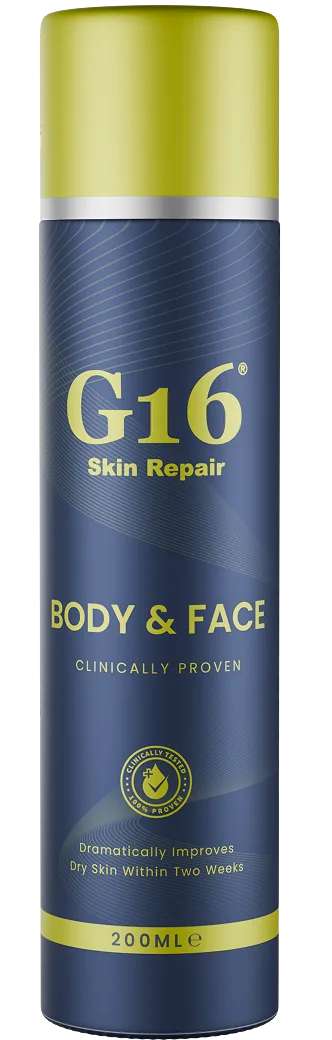
G16 Skin Repair Lotion is a cosmetic moisturiser. Patch test on a small area before first use, keep it away from the eyes and mucous membranes, and keep it out of reach of children. If your skin is broken, bleeding or infected, or if it gets worse rather than better, speak to a GP or a dermatologist.
