



Itching that will not stop is exhausting in a way that is difficult to explain to anyone who has not had it. It wakes you at three in the morning. It makes you short-tempered. And scratching buys about four seconds of relief before making the next hour worse.
The mechanism is simple enough: when the skin barrier is damaged, nerve endings get irritated by things that would normally never reach them, and the brain reports that as itch. Scratching damages the barrier further, which causes more itch. That is the itch-scratch cycle, and breaking it matters more than almost anything else you do.
First, the important part: not all itch is dry skin
Itch is a symptom with a long list of causes, and some of them are serious. This is the one page in this series where the medical section comes first, because getting the cause wrong wastes months.
| If the itch is... | Consider |
|---|---|
| All over, with no rash at all | Thyroid disease, kidney disease, liver problems, iron deficiency, and less commonly lymphoma. Generalised itch without a rash should always be investigated |
| Worse at night, spreading, between the fingers | Scabies. Very itchy, contagious, and needs specific treatment. Common and frequently missed |
| With red, inflamed, weeping patches | Eczema. Needs anti-inflammatory treatment, not just moisturiser |
| With thick silvery-scaled plaques | Psoriasis |
| With raised weals that move around | Urticaria, or hives. Often an allergic or histamine response |
| Confined to feet, peeling between toes | Fungal infection, needing an antifungal |
| Started within weeks of a new medication | A drug reaction. Opioids, some blood pressure drugs and others are common causes |
| In pregnancy, especially palms and soles | See a midwife or doctor promptly. Can indicate obstetric cholestasis, which needs monitoring |
If your itch fits any of those better than it fits plain dryness, treat that rather than reaching for a lotion.
When it genuinely is dry skin
Itch from dryness usually looks like this: skin is visibly dry, rough or flaky; it is worse after washing, in winter, and in the evening; there is no true rash, though there may be scratch marks; and it improves when you moisturise properly.
Breaking the itch-scratch cycle
Cool it
Cold suppresses itch nerves directly and works within seconds. A cool damp flannel or a cold pack wrapped in a cloth, ten minutes. Keeping moisturiser in the fridge makes it more effective on contact. Heat does the opposite, which is why itch peaks in a warm bed.
Protect the skin from yourself
Keep nails cut very short. Cotton gloves at night sound ridiculous and stop a great deal of unconscious night-time scratching. If you must respond to the itch, press or pinch rather than scratching.
Moisturise, generously and often
Emollients are the foundation of managing itchy dry skin. Apply within three minutes of bathing, and reapply through the day. Fragrance-free, because fragrance is the most common cause of contact irritation in skincare.
Stop the things that provoke it
- Hot showers and baths. Lukewarm only.
- Soap and foaming shower gels.
- Wool and rough synthetics directly against the skin. Cotton or silk instead.
- Biological detergents and fabric softener.
- Overheating, especially in bed. A cooler bedroom helps significantly.
- Alcohol in the evening, which dilates skin vessels and worsens itch for many people.
Antihistamines: manage your expectations
Non-sedating antihistamines work well for itch driven by histamine, meaning hives and allergy. They do very little for dry-skin itch, because that is not a histamine problem. A sedating antihistamine at night sometimes helps by improving sleep rather than by treating the itch itself. Worth discussing with a pharmacist.
Where G16 fits, and where it does not
This is a page where the honest answer needs stating clearly.
If your skin is itchy and inflamed, G16 is not the right product. Acids on inflamed skin sting and can make things worse. That situation needs the inflammation settled first, usually with an emollient and often something anti-inflammatory from a GP.
Where it does fit is the version where itch comes from built-up scale rather than inflammation. Thickened, scaly skin flakes and cracks, and those micro-cracks are themselves itchy. Clearing the build-up removes the cause, and people with ichthyosis and very dry scaly skin often report the itch settling as the scale clears. The glycerin, aloe vera, panthenol and allantoin also hydrate as it works.
So: scaly and itchy, it may help. Red, raw and itchy, treat that first.
When to see a doctor
- Itch all over with no rash. This warrants blood tests rather than a moisturiser.
- Itch that disturbs your sleep.
- Itch in pregnancy, particularly on palms and soles, which should be checked promptly.
- Skin broken, weeping, crusted or infected from scratching.
- Alongside weight loss, night sweats, fatigue or jaundice.
- Worse at night and other people in the house are itching too, which strongly suggests scabies.
- No improvement after several weeks of good emollient use.
Common questions
Several things line up in the evening. Skin temperature rises and warmth amplifies itch. Water loss through the skin peaks overnight. Cortisol, which has an anti-inflammatory effect, is at its daily low. And there are fewer distractions, so you simply notice it more. A cooler bedroom and moisturising last thing both help.
Usually not much. Dry-skin itch is not primarily driven by histamine, so non-sedating antihistamines tend to disappoint. They work well for hives and allergic itch. A sedating one at night may help you sleep through it, which is a genuine benefit even though it is not treating the cause.
It can be, which is why it is worth taking seriously. Persistent generalised itch without a rash can point to thyroid, kidney or liver problems, iron deficiency, or occasionally something more significant. It is often nothing, but it is the presentation that most deserves a GP appointment and some blood tests rather than another cream.
It feels wonderful for about a minute and then makes everything worse. Heat temporarily overrides the itch signal, which is why it is so tempting, but it also strips the oils holding water in your skin, so the itch returns harder within the hour. Lukewarm, brief, then moisturise on damp skin.
The product behind this guide
G16 Skin Repair is a glycolic and lactic acid body lotion for built-up, scaly and thickened skin.
200ml. Made in the UK. 21 day money back guarantee.
Dry skin treatment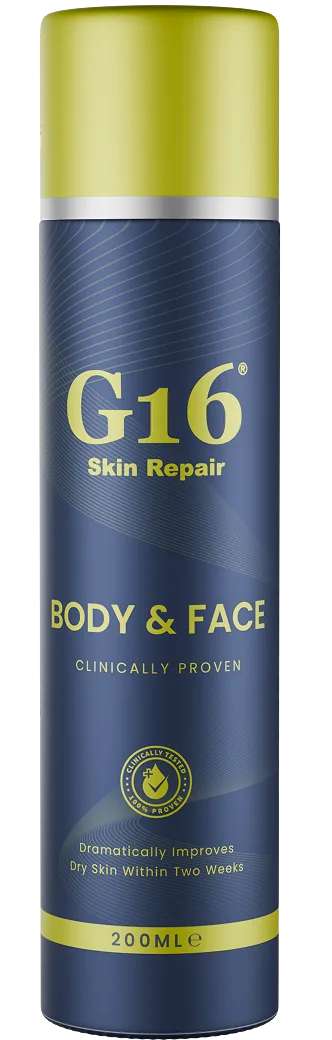
G16 Skin Repair Lotion is a cosmetic moisturiser. Patch test on a small area before first use, keep it away from the eyes and mucous membranes, and keep it out of reach of children. If your skin is broken, bleeding or infected, or if it gets worse rather than better, speak to a GP or a dermatologist.
