



Almost everyone tackles dry skin by buying another moisturiser. That is step four, not step one. Work through it in order and you will usually get there faster and spend less, because the biggest wins are things you stop doing rather than things you buy.
Here is the order that works.
Step 1: Stop stripping it
Before adding anything, remove what is taking moisture out. For a lot of people this alone is enough.
- Cooler showers, and shorter. Hot water dissolves the oils holding water in your skin. Lukewarm, under ten minutes.
- Stop using soap on your whole body. Soap is alkaline and strips the skin's acid mantle. A non-soap cleanser, sometimes labelled syndet, used only where you need it. The more a product lathers, the more it is stripping.
- Pat dry, do not rub.
- Check your laundry detergent if the dryness is where clothing sits. Biological detergents and fabric softeners are common irritants.
Give this two weeks before deciding it has not worked.
Step 2: Moisturise at the right moment
Timing matters more than the product. Apply within three minutes of getting out of the bath or shower, while the skin is still damp. You are trapping the water already there, rather than trying to add it later.
Twice a day if the skin is genuinely dry. Once is a compromise.
Step 3: Fix the air
If your dryness is seasonal, the environment is the cause and no product will out-run it. A humidifier in the bedroom is the highest-value purchase in this whole list for winter dryness. Aim for 40 to 60 per cent.
Step 4: Now choose the right product
This is where most people start, and where the mismatch usually happens. Products for dry skin do one of three jobs:
| Type | What it does | Use when |
|---|---|---|
| Occlusive | Sits on top, physically slows water escaping. Petrolatum, mineral oil, dimethicone, shea butter | Skin is very dry or the air is very dry. Greasiest, most effective |
| Humectant | Pulls water into the outer layer. Glycerin, hyaluronic acid, low-dose urea, panthenol | Mild dryness, or under an occlusive. Light and comfortable |
| Keratolytic | Loosens dead cells so build-up comes away. Glycolic and lactic acid, high-dose urea, salicylic acid | Skin is scaly, flaky or rough and moisturiser keeps failing |
The test that saves you money. Run a fingernail gently across the dry patch. If a flake or fine scale lifts, you have a build-up problem and you need something keratolytic. Buying a sixth moisturiser will not fix it. If nothing lifts and the skin is simply tight, you have a water problem and a good emollient is the correct and cheaper answer.
Step 5: Work out whether it is dryness at all
Several things look like dry skin and are not. If four weeks of the above has changed nothing, consider:
- Eczema. Red, inflamed, intensely itchy, often in the creases of elbows and knees. Needs anti-inflammatory treatment, not just moisturiser.
- Psoriasis. Well-defined thick plaques with silvery scale, often on elbows, knees and scalp.
- Ichthyosis vulgaris. Lifelong fine scale on shins and outer arms, better in humidity, runs in families.
- Keratosis pilaris. Rough bumps rather than flat dryness.
- Fungal infection. Particularly on the feet, with itching and peeling between the toes.
- An underactive thyroid, diabetes or kidney disease, all of which show in the skin.
- A medication you started recently. Diuretics, statins and retinoids are frequent culprits.
What to skip
- Drinking more water, unless you are actually dehydrated. The outer layer of skin takes its water from the air and from what you apply, not from your last glass.
- Body scrubs. Physical abrasion irritates and the irritation prompts more keratin. Chemical exfoliation is both gentler and more effective.
- Anything with a strong fragrance, which is the most common cause of contact irritation in skincare.
- Expensive serums for the body. The active ingredients that work on body skin are cheap and well established.
Where G16 fits
G16 Skin Repair is the third column in that table. It is a glycolic and lactic acid lotion, so it is for the version of dry skin where dead skin has built up and will not shed, and it hydrates underneath with aloe vera, glycerin, panthenol and shea butter while it does.
If your dry skin is scaly, flaky or rough, and ordinary moisturisers give you a few soft hours and then the roughness returns, that is the pattern it addresses. If your skin is simply tight and dehydrated with nothing to remove, a plain emollient is cheaper and better suited, and we would rather say so.
When to see a doctor
- The skin is cracked deeply enough to bleed, or looks infected.
- Itching is disturbing your sleep.
- It came on suddenly with no obvious cause.
- It is not improving after four to six weeks of doing the above properly.
- There are other symptoms: fatigue, weight change, unusual thirst, swollen ankles.
Common questions
Simple environmental dryness usually settles within one to two weeks of changing how you wash and moisturise. Built-up scale takes longer, since the accumulation has to clear first: most people see a visible difference within the first two weeks and a full course is around 28 days. If nothing has changed after six weeks, the diagnosis is probably wrong.
For body skin, rarely. The ingredients that genuinely work, petrolatum, glycerin, urea, the alpha hydroxy acids, are all inexpensive and long established. What matters is choosing the right category for your problem and applying it consistently at the right time. Price mostly buys texture and fragrance.
Only if there is genuine build-up, and chemically rather than with a scrub. If your skin is tight and dehydrated but smooth, exfoliating damages a barrier that is already struggling. If it is scaly and flakes lift, then loosening that build-up is exactly what it needs.
Facial skin is thinner and more reactive, so a heavy body product can clog pores or irritate. Some products are formulated for both and say so. If a body lotion contains acids, patch test on a small area of the face first and keep it well away from the eyes.
The product behind this guide
G16 Skin Repair is a glycolic and lactic acid body lotion for built-up, scaly and thickened skin.
200ml. Made in the UK. 21 day money back guarantee.
Dry skin treatment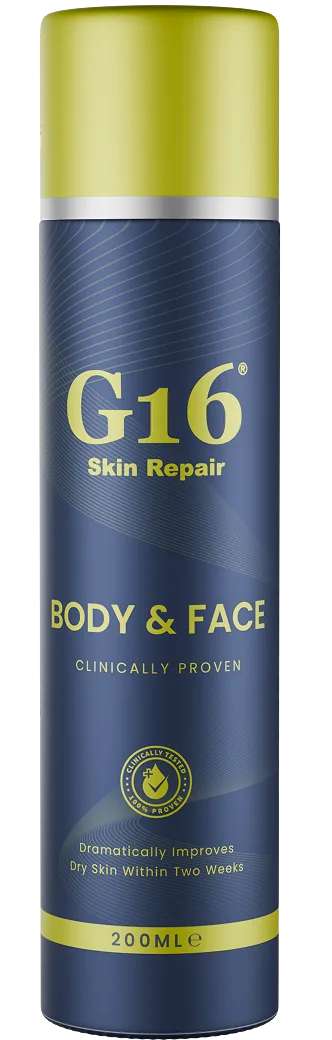
G16 Skin Repair Lotion is a cosmetic moisturiser. Patch test on a small area before first use, keep it away from the eyes and mucous membranes, and keep it out of reach of children. If your skin is broken, bleeding or infected, or if it gets worse rather than better, speak to a GP or a dermatologist.
